Pakistan's Volatile North-West Frontier: Pashtun Tribes, Taliban, and al-Qaeda
Washington, DC: December 14, 2006
Event Summary
Speakers:
Hassan Abbas, Fellow, Harvard's JFK School of Government
Michael Scheuer, Senior Fellow, The Jamestown Foundation
Summary:
On December 14, The Jamestown Foundation hosted an event featuring Hassan Abbas, a fellow at Harvard's JFK School of Government, and Michael Scheuer, a senior fellow at The Jamestown Foundation and the former chief of the CIA's Osama bin Laden unit. More than 90 guests attended the conference, which was titled Pakistan's Volatile North-West Frontier: Pashtun Tribes, Taliban, and al-Qaeda.
Hassan Abbas, who is a former Sub-Divisional Police Chief in the NWFP and former Deputy Director of Investigations in Pakistan's National Accountability Bureau from 1999-2000, began the conference by highlighting some critical issues affecting stability in Pakistan and Afghanistan:
Pakistan and Afghanistan have reached an unprecedented level of tension over the border. Musharraf is dangerously close to losing control of the tribal regions. The traditional tribal maliks, a cornerstone in governing the tribal belt, are being assassinated in growing numbers. NWFP Governor Orakzai, who was appointed by Musharraf, has lost credibility with his own people, the Pashtuns, as a result of the recent Bajaur Agency airstrike. Foreign aid to Pakistan is not reaching the tribal areas. Musharraf faces increasing pressure from the Pashtun element in the military.
Before analyzing these issues, Mr. Abbas presented a detailed overview of the Federally Administered Tribal Areas (FATA) and the NWFP:
Wahhabi and Deobandi influences are strong in the tribal regions, but especially so in North and South Waziristan. There are approximately 60 major Pashtun tribes, yet more than 400 sub-clans. The Pashtuns in the tribal belt profit from trading, tracking, trucking and trafficking. Education levels are low. The entire border region has been a rentier state historically. Pashtuns have not surrendered control of their territory to outside forces; nevertheless, they are prone to compromise. Suicide bombings were largely unheard of in the region until recently. Now, the number of suicide attacks has escalated significantly in both Afghanistan and Pakistan. The Durand Line, which separates Pakistan and Afghanistan, is long and twisted, making it very difficult to patrol. Despite there being some 186 check points on the Pakistan side of the border, human traffic continues to flow between the two states.
Mr. Abbas then outlined the current ground realities in the tribal regions. While Pakistan's writ in the tribal areas has always been minimal, the U.S.-led intervention in Afghanistan exacerbated the problem. Islamabad's political agents in the tribal agencies are under constant threat of attack, and those accused of supporting the government are regularly killed. Extremist tendencies are on the rise in the tribal belt, and some of this has to do with al-Qaeda's influence. Tribal maliks are being killed at an unprecedented rate, with some 200 assassinated in the last two years. This has resulted in the elimination of the traditional tribal leadership.
In an especially revealing statement, Mr. Abbas explained a primary reason for the difficulty in controlling the tribal areas. While the Pakistani army is mainly composed of Punjabis, approximately 20-25 percent of it is Pashtun. Due to Pashtun culture, these Pashtun soldiers regularly take leave at their homes in the tribal regions, sometimes every two to three weeks. Here they are influenced by developments "back home," which pressures the Pakistani government to keep this section of the military satisfied. According to Mr. Abbas, this may be one reason why Musharraf has tried to establish peace deals in the tribal agencies.
Mr. Abbas then offered some solutions to alleviate the strain in the tribal areas:
Negotiate with Afghan and Pashtun leaders in tribal jirga format rather than round table discussions. Attempt to revitalize secular forces in the tribal areas, such as Asfandyar Wali Khan, the leader of the Awami National Party. Consider incorporating some of the tribal areas into the settled areas of the NWFP. Recognize that the military option has not worked. Oversee Pakistan's spending policies in the tribal areas since much of the foreign aid coming to Pakistan for this purpose is not evident on the ground. Increase infrastructure investment in Afghanistan in order to dull the draw that this conflict has on Pashtuns in the tribal belt. Allow journalists and human rights organizations into the tribal areas.
After Hassan Abbas' speech, Michael Scheuer examined al-Qaeda's involvement in FATA and the NWFP, the border areas in general, how intelligence gathering is accomplished on the Frontier and ways ahead. According to Mr. Scheuer, Osama bin Laden established bases and contacts in the border region throughout the 1980s, well before the creation of al-Qaeda. This influence originated when Abdullah Azzam and bin Laden created the Afghan Services Bureau to coordinate humanitarian and military operations in Afghanistan during the jihad against the Soviets. In the early 1980s, bin Laden developed a working relationship with Pakistan's Inter-Services Intelligence (ISI) and the Pakistan Army. This relationship facilitated bin Laden's access to the border regions. During this time, bin Laden established ties with notorious Afghan figures, such as Gulbuddin Hekmatyar and Qazi Mohammad. It was these various ties that assisted Osama bin Laden and the core al-Qaeda leadership in their escape from Tora Bora in 2001.
Mr. Scheuer then explained how intelligence work in the border areas is conducted. The tribal areas present a formidable obstacle in acquiring intelligence since the Pashtuns are divided into various sub-tribes and are often at odds with each other. The society is very insular and Westerners are not welcome, making it difficult to insert Special Forces units into the region. While it is possible to recruit Pashtuns to assist outside forces in intelligence gathering, it is almost impossible to recruit a Pashtun that will condemn another Pashtun or even a non-Pashtun Muslim. Furthermore, after nearly three decades of conflict, the Pashtun brand of Islam has moved closer to the more conservative standard of the Middle East. Not only do Western intelligence services suffer from these factors, but Pakistan's own ISI and military also encounter the same problems. An even more basic dilemma is the topography of the region and the nature of the border--to this day, accurate maps are difficult to find, even for the intelligence services.
According to Mr. Scheuer, the outlook for the region is not positive. Karzai's government in Kabul is in a state of demise and is increasingly unpopular at home. Failure to secure the border will mean that Pashtun and al-Qaeda insurgents will continue to engage in attacks in Afghanistan and then use Pakistan as a rear base, remaining free from U.S. and NATO reprisals.
Founded in 1984, The Jamestown Foundation is an independent, non-partisan research institution dedicated to providing timely information concerning critical political and strategic developments in China, Russia, Eurasia and the Greater Middle East. Jamestown produces five periodic publications: Eurasia Daily Monitor, Terrorism Monitor, Terrorism Focus, Chechnya Weekly and China Brief. Jamestown research and analysis is available to the public free-of-charge via Jamestown's website.
Showing posts sorted by relevance for query Jamestown foundation. Sort by date Show all posts
Showing posts sorted by relevance for query Jamestown foundation. Sort by date Show all posts
Friday, December 22, 2006

Thursday, October 19, 2006
The West is Running Out of Time in Afghanistan
The West is Running Out of Time in Afghanistan
10/17/2006 - By Michael Scheuer (from Terrorism Focus) - Jamestown Foundation
From all observables, the Taliban insurgency is spreading from its deeply rooted base in southern and southeastern Afghanistan to provinces in the west and east. In addition, several Islamist insurgent organizations active during the 1979-89 jihad against the Soviet Union's occupation of Afghanistan—the "old mujahideen"—have allied themselves with the Taliban. Among the more important and militarily powerful of these long-established groups are Gulbuddin Hekmatyar's Hezb-e-Islami and the forces of Maulana Jalaluddin Haqqani, which belong to the Hezb-e-Islami-Khalis organization. Historically, both groups have been able to deploy substantial forces in the strategically vital corridors from the Khyber Pass through Jalalabad to Kabul, and along the only major highway running from Kabul to the southern provinces. Prior to the 2001 U.S.-led invasion, the first of these organizations was hostile to the Taliban, while the second was at best neutral toward it (Asia Times, October 5).
Also noticeable in 2006 has been the strongly Afghan-centric nature of the insurgency. As in the jihad against the Red Army, the most important insurgent forces are made up of the Afghans themselves. Since Western leaders and the media focus so much attention on Osama bin Laden's al-Qaeda, the Afghans' dominant role in the war is often lost sight of. While al-Qaeda fighters and other so-called foreign fighters are active in Afghanistan—London's al-Hayat reports that more and more Saudi men are going to fight there since the Taliban assumed the military initiative this year—they are important but secondary contributors to the war effort (al-Hayat, October 3). As in the 1980s, the Afghans publicly and correctly point out that the U.S.-led coalition is increasingly facing a "nation in arms." On this question, for example, Taliban spokesman Abdul-Hai Mutamen highlighted the always intense nationalism and xenophobia of his countrymen when he said that while Afghans and foreign fighters "have spiritual sympathy with each other...Our resistance is a pure Afghan resistance" (Pakistan Observer, October 8).
Another aspect of the Taliban's current agenda that is identical to the mujahideen's political tack in the 1980s is its definitive position that it will not participate in, or even negotiate with, President Karzai's government. In words familiar to those knowledgeable about the absolute intransigence of the Soviet-era mujahideen leaders, Taliban spokesman Mutamen recently explained that there would be no peace talks with Kabul because: "There is no independent government in Afghanistan now. The foreigners have established the current government. The occupying forces should first leave Afghanistan. We can then think of future peace talks...Our resistance, which has now spread throughout the country, is not for the sake of power or government. This is a very silly thought. We want to regain independence so our people can live under the system which they desire which is, of course, and Islamic government" (Afghan Islamic Press, October 7).
As much as the Taliban's improved military performance is an ill omen for Karzai's government and the U.S.-led coalition, three other factors greatly augment the progress that the Taliban is making on the battlefield:
Law-and-order: Western media reporting, newspapers published in Kabul, Herat and Kandahar, and statements by the Taliban show that crime rates are high in urban areas and that much of rural Afghanistan is plagued by bandits, warlords and narcotics traffickers. In other words, the law-and-order situation in most of the country is uncannily similar to the neatly anarchic environment that helped facilitate the Taliban's ascendancy in 1996. The failure of the Karzai government and its Western allies to deploy enough military forces to establish a reliable, country-wide law-and-order regime is the Taliban's most valuable non-military ally. Afghans invariably put the security of their families, businesses and farms above the implementation of elections and parliaments.
Pakistan and Waziristan: The Afghan government and some Western officials have condemned Pakistani President Pervez Musharraf's peace deal with the Pashtun tribes in the country's Waziristan region as being intended to strengthen the Taliban. The reality, however, seems to be that Musharraf made the deal because his army's presence in the tribal lands had become unsustainable politically. In addition to suffering heavy casualties in fighting Pashtun tribes, the Taliban and al-Qaeda in Waziristan—heavier casualties than those sustained by the U.S.-led coalition in Afghanistan—the Pakistani army's "invasion" of the province smashed Islamabad's 50-year-old modus vivendi with the tribes to live-and-let-live and brought the area to the verge of civil war. In making peace, Musharraf did what he had to do by choosing to protect Pakistan's political stability and geographic integrity over continuing an armed intervention that threatened both and which would ultimately be feckless because of the U.S.-led coalition's failure to defeat the Taliban and control the Afghan countryside. There is no question that the Taliban is stronger because of the deal—if for no other reason than the safe haven it provided—but so is Pakistan's political stability, which was being undermined by the radicalizing impact that the army's incursion had on the country's powerful pro-Taliban and pro-al-Qaeda religious parties (Daily Times, October 3).
Time: The old adage that familiarity breeds contempt is no place on earth truer than in Afghanistan, and there it additionally always breeds armed resistance. In the Afghans' view, the U.S.-led coalition has occupied Afghanistan for five-plus years, has failed to deliver a more prosperous and safer society, has killed a large number of Afghan civilians and shows no sign of planning a near-term departure. Always short of patience in regard to foreigners running their affairs, most Afghans probably would concur with Taliban spokesman Mutamen's statement that "the people of Afghanistan...never accept foreign dominance...America has attacked Afghanistan without any reasonable plan or suggestions. The Americans, therefore, get nothing but the death of their soldiers in Afghanistan. We want NATO and other foreign troops to leave Afghanistan as soon as possible" (Afghan Islamic Press, October 7). Ominously, another Taliban leader, Mullah Mehmood Allah Haq Yar, claims that not only has the Pashtun-dominated Taliban's patience run out, but that the forces of the late Ahmed Shah Masood—heretofore backing Karzai—are beginning to decide that they did not defeat and evict Moscow only to be ruled by the West. In late spring 2005, Yar claims to have talked with Northern Alliance representatives who "condemned the foreign presence in the country, but insisted that the Taliban take the lead [in attacking it] and then they would follow suit." Yar claims that the Taliban's contacts with the Alliance commanders are continuing (Asia Times, October 5).
Overall, the increasing pace of the Taliban-led insurgency in Afghanistan suggests it is only a matter of time until the commanders of the U.S.-led coalition are faced with telling their political leaders that a decision must be made to either heavily reinforce coalition forces—it appears that more than the 120,000 men Moscow deployed to Afghanistan in the 1980s would be necessary—or begin preparations to withdraw from the country. If taken now, such a decision would be made in the context of polls showing popular opinion in Canada and Britain turning decidedly against continued participation in the Afghan war and media reports that France may begin to withdraw its special forces from Afghanistan next spring (Associated Press, October 15).
Michael Scheuer served as the Chief of the bin Laden Unit at the CIA's Counterterrorist Center from 1996 to 1999. He is now a Senior Fellow at The Jamestown Foundation.
10/17/2006 - By Michael Scheuer (from Terrorism Focus) - Jamestown Foundation
From all observables, the Taliban insurgency is spreading from its deeply rooted base in southern and southeastern Afghanistan to provinces in the west and east. In addition, several Islamist insurgent organizations active during the 1979-89 jihad against the Soviet Union's occupation of Afghanistan—the "old mujahideen"—have allied themselves with the Taliban. Among the more important and militarily powerful of these long-established groups are Gulbuddin Hekmatyar's Hezb-e-Islami and the forces of Maulana Jalaluddin Haqqani, which belong to the Hezb-e-Islami-Khalis organization. Historically, both groups have been able to deploy substantial forces in the strategically vital corridors from the Khyber Pass through Jalalabad to Kabul, and along the only major highway running from Kabul to the southern provinces. Prior to the 2001 U.S.-led invasion, the first of these organizations was hostile to the Taliban, while the second was at best neutral toward it (Asia Times, October 5).
Also noticeable in 2006 has been the strongly Afghan-centric nature of the insurgency. As in the jihad against the Red Army, the most important insurgent forces are made up of the Afghans themselves. Since Western leaders and the media focus so much attention on Osama bin Laden's al-Qaeda, the Afghans' dominant role in the war is often lost sight of. While al-Qaeda fighters and other so-called foreign fighters are active in Afghanistan—London's al-Hayat reports that more and more Saudi men are going to fight there since the Taliban assumed the military initiative this year—they are important but secondary contributors to the war effort (al-Hayat, October 3). As in the 1980s, the Afghans publicly and correctly point out that the U.S.-led coalition is increasingly facing a "nation in arms." On this question, for example, Taliban spokesman Abdul-Hai Mutamen highlighted the always intense nationalism and xenophobia of his countrymen when he said that while Afghans and foreign fighters "have spiritual sympathy with each other...Our resistance is a pure Afghan resistance" (Pakistan Observer, October 8).
Another aspect of the Taliban's current agenda that is identical to the mujahideen's political tack in the 1980s is its definitive position that it will not participate in, or even negotiate with, President Karzai's government. In words familiar to those knowledgeable about the absolute intransigence of the Soviet-era mujahideen leaders, Taliban spokesman Mutamen recently explained that there would be no peace talks with Kabul because: "There is no independent government in Afghanistan now. The foreigners have established the current government. The occupying forces should first leave Afghanistan. We can then think of future peace talks...Our resistance, which has now spread throughout the country, is not for the sake of power or government. This is a very silly thought. We want to regain independence so our people can live under the system which they desire which is, of course, and Islamic government" (Afghan Islamic Press, October 7).
As much as the Taliban's improved military performance is an ill omen for Karzai's government and the U.S.-led coalition, three other factors greatly augment the progress that the Taliban is making on the battlefield:
Law-and-order: Western media reporting, newspapers published in Kabul, Herat and Kandahar, and statements by the Taliban show that crime rates are high in urban areas and that much of rural Afghanistan is plagued by bandits, warlords and narcotics traffickers. In other words, the law-and-order situation in most of the country is uncannily similar to the neatly anarchic environment that helped facilitate the Taliban's ascendancy in 1996. The failure of the Karzai government and its Western allies to deploy enough military forces to establish a reliable, country-wide law-and-order regime is the Taliban's most valuable non-military ally. Afghans invariably put the security of their families, businesses and farms above the implementation of elections and parliaments.
Pakistan and Waziristan: The Afghan government and some Western officials have condemned Pakistani President Pervez Musharraf's peace deal with the Pashtun tribes in the country's Waziristan region as being intended to strengthen the Taliban. The reality, however, seems to be that Musharraf made the deal because his army's presence in the tribal lands had become unsustainable politically. In addition to suffering heavy casualties in fighting Pashtun tribes, the Taliban and al-Qaeda in Waziristan—heavier casualties than those sustained by the U.S.-led coalition in Afghanistan—the Pakistani army's "invasion" of the province smashed Islamabad's 50-year-old modus vivendi with the tribes to live-and-let-live and brought the area to the verge of civil war. In making peace, Musharraf did what he had to do by choosing to protect Pakistan's political stability and geographic integrity over continuing an armed intervention that threatened both and which would ultimately be feckless because of the U.S.-led coalition's failure to defeat the Taliban and control the Afghan countryside. There is no question that the Taliban is stronger because of the deal—if for no other reason than the safe haven it provided—but so is Pakistan's political stability, which was being undermined by the radicalizing impact that the army's incursion had on the country's powerful pro-Taliban and pro-al-Qaeda religious parties (Daily Times, October 3).
Time: The old adage that familiarity breeds contempt is no place on earth truer than in Afghanistan, and there it additionally always breeds armed resistance. In the Afghans' view, the U.S.-led coalition has occupied Afghanistan for five-plus years, has failed to deliver a more prosperous and safer society, has killed a large number of Afghan civilians and shows no sign of planning a near-term departure. Always short of patience in regard to foreigners running their affairs, most Afghans probably would concur with Taliban spokesman Mutamen's statement that "the people of Afghanistan...never accept foreign dominance...America has attacked Afghanistan without any reasonable plan or suggestions. The Americans, therefore, get nothing but the death of their soldiers in Afghanistan. We want NATO and other foreign troops to leave Afghanistan as soon as possible" (Afghan Islamic Press, October 7). Ominously, another Taliban leader, Mullah Mehmood Allah Haq Yar, claims that not only has the Pashtun-dominated Taliban's patience run out, but that the forces of the late Ahmed Shah Masood—heretofore backing Karzai—are beginning to decide that they did not defeat and evict Moscow only to be ruled by the West. In late spring 2005, Yar claims to have talked with Northern Alliance representatives who "condemned the foreign presence in the country, but insisted that the Taliban take the lead [in attacking it] and then they would follow suit." Yar claims that the Taliban's contacts with the Alliance commanders are continuing (Asia Times, October 5).
Overall, the increasing pace of the Taliban-led insurgency in Afghanistan suggests it is only a matter of time until the commanders of the U.S.-led coalition are faced with telling their political leaders that a decision must be made to either heavily reinforce coalition forces—it appears that more than the 120,000 men Moscow deployed to Afghanistan in the 1980s would be necessary—or begin preparations to withdraw from the country. If taken now, such a decision would be made in the context of polls showing popular opinion in Canada and Britain turning decidedly against continued participation in the Afghan war and media reports that France may begin to withdraw its special forces from Afghanistan next spring (Associated Press, October 15).
Michael Scheuer served as the Chief of the bin Laden Unit at the CIA's Counterterrorist Center from 1996 to 1999. He is now a Senior Fellow at The Jamestown Foundation.
Thursday, March 31, 2005
What's happening in Gwadar
GWADAR: CHINA'S NAVAL OUTPOST ON THE INDIAN OCEAN
By Tarique Niazi
CHINA BRIEF
The Jamestown Foundation
Volume 5 , Issue 4 (February 15, 2005)
Four months after the U.S. ordered its troops into Afghanistan to remove the Taliban regime, China and Pakistan joined hands to break ground in building a Deep Sea Port on the Arabian Sea. The project was sited in an obscure fishing village of Gwadar in Pakistan's western province of Baluchistan, bordering Afghanistan to the northwest and Iran to the southwest. Gwadar is nautically bounded by the Persian Gulf in the west and the Gulf of Oman in the southwest.
Although the Gwadar Port project has been under study since May 2001, the U.S. entrée into Kabul provided an added impetus for its speedy execution. Having set up its bases in Central, South, and West Asian countries, the U.S. virtually brought its military forces at the doorstep of China. Beijing was already wary of the strong U.S. military presence in the Persian Gulf, which supplies 60% of its energy needs. It was now alarmed to see the U.S. extend its reach into Asian nations that ring western China. Having no blue water navy to speak of, China feels defenseless in the Persian Gulf against any hostile action to choke off its energy supplies. This vulnerability set Beijing scrambling for alternative safe supply routes for its energy shipments. The planned Gwadar Deep Sea Port was one such alternative for which China had flown its Vice Premier, Wu Bangguo, to Gwadar to lay its foundation on March 22, 2002.
Pakistan was interested in the project to seek strategic depth further to the southwest from its major naval base in Karachi that has long been vulnerable to the dominant Indian Navy. In the past, it endured prolonged economic and naval blockades imposed by the Indian Navy. To diversify the site of its naval and commercial assets, Pakistan has already built a naval base at Ormara, the Jinnah Naval Base, which has been in operation since June 2000. It can berth about a dozen ships, submarines and similar harbor craft. The Gwadar port project, however, is billed to crown the Pakistan Navy into a force that can rival regional navies. The government of Pakistan has designated the port area as a "sensitive defense zone." Once completed, the Gwadar port will rank among the world's largest deep-sea ports.
The convergence of Sino-Pakistani strategic interests has put the port project onto a fast track to its early completion. In three years since its inauguration, the first phase of the project is already complete with three functioning berths. The Chinese Premier Wen Jiabao will be on hand to mark the completion of this phase in March this year. Although the total cost of the project is estimated at $1.16 billion USD, China pitched in $198 million and Pakistan $50 million to finance the first phase. China also has invested another $200 million into building a coastal highway that will connect the Gwadar port with Karachi. The second phase, which will cost $526 million, will feature the construction of 9 more berths and terminals and will also be financed by China. To connect western China with Central Asia by land routes, Pakistan is working on building road links to Afghanistan from its border town of Chaman in Baluchistan to Qandahar in Afghanistan. In the northwest, it is building similar road links between Torkham in Pakhtunkhaw (officially known as the Northwest Frontier Province) and Jalalabad in Afghanistan. Eventually, the Gwadar port will be accessible for Chinese imports and exports through overland links that will stretch to and from Karakoram Highway in Pakistan's Northern Areas that border China's Muslim-majority Autonomous Region of Xinjiang. In addition, the port will be complemented with a modern air defense unit, a garrison, and a first-rate international airport capable of handling airbus service.
Pakistan already gives China most favored nation (MFN) status and is now establishing a bilateral Free Trade Area (FTA), which will bring tariffs between the two countries to zero. Over the past two years, the trade volume between the two countries has jumped to $2.5 billion a year, accounting for 20% of China's total trade with South Asia. Informal trade, a euphemism for smuggling, however, is several times the formal trade. The proposed FTA is an implicit acceptance of the unstoppable "informal" trade as a "formal" one. More importantly, Chinese investment in Pakistan has increased to $4 billion, registering a 30% increase just over the past two years since 2003. Chinese companies make up 12% (60) of the foreign firms (500) operating in Pakistan, which employ over 3,000 Chinese nationals.
The growing economic cooperation between Beijing and Islamabad is also solidifying their strategic partnership. Before leaving for his visit to Beijing this past December, Pakistani Prime Minister Aziz told reporters in Islamabad: "Pakistan and China are strategic partners and our relations span many areas." The rhetoric of strategic alignment is duly matched by reality. Last year, China and Pakistan conducted their first-ever joint naval exercises near the Shanghai coast. These exercises, among others, included simulation of an emergency rescue operation. Last December, Pakistan opened a consulate in Shanghai. The Gwadar Port project is the summit of such partnership that will bring the two countries closer in maritime defense as well.
Initially, China was reluctant to finance the Gwadar port project because Pakistan offered the U.S. exclusive access to two of its critical airbases in Jacobabad (Sind) and Pasni (Baluchisntan) during the U.S. invasion of Afghanistan. According to a Times of India report on February 19, 2002, Gen. Musharraf had to do a lot of explaining for leasing these bases to America. China, the Times of India reported, was also upset with Pakistan for allowing the U.S. to establish listening posts in Pakistan's Northern Areas, which border Xinjiang and Tibet. When China finally agreed to offer financial and technical assistance for the project, it asked for "sovereign guarantees" to use the Port facilities to which Pakistan agreed, despite U.S. unease over it.
In particular, the port project set off alarm bells in India which already feels encircled by China from three sides: Myanmar, Tibet, and Pakistan. To counter Sino-Pak collaboration, India has brought Afghanistan and Iran into an economic and strategic alliance. Iranians are already working on Chabahar port in Sistan-Baluchistan, which will be accessible for Indian imports and exports with road links to Afghanistan and Central Asia. India is helping build a 200-kilometer road that will connect Chabahar with Afghanistan. Once completed, Indians will use this access road to the port for their imports and exports to and from Central Asia. Presently, India is in urgent need of a shorter transit route to quickly get its trade goods to Afghanistan and Central Asia.
These external concerns are stoking internal challenges to the port project. Baluchistan, where the project is located, is once again up in arms against the federal government. The most important reason for armed resistance against the Gwadar port is that Baluch nationalists see it as an attempt to colonize them and their natural resources. Several insurgent groups have sprung up to nip the project in the bud. The three most popular are: the Baluchistan Liberation Army, Baluchistan Liberation Front, and People's Liberation Army. On May 3, 2004, the BLA killed three Chinese engineers working on the port project that employs close to 500 Chinese nationals. On October 9, 2004, two Chinese engineers were kidnapped in South Waziristan in the northwest of Pakistan, one of whom was killed later on October 14 in a botched rescue operation. Pakistan blamed India and Iran for fanning insurgency in Baluchistan.
Moreover, the Chinese in Pakistan are vulnerable because of their tense relationship with the Uighur Muslim majority of Xinjiang. Stretched over an area of 635,833 square miles, Xinjiang is more than twice the size of Pakistan, and one-sixth of China's landmass. However, it dwarfs in demographic size with a population of 19 million people. Beijing is investing 730 billion yuan (roughly $88 billion USD) in western China, including Xinjiang, which opens it up to the six Muslim countries of Afghanistan, Kazakhstan, Kyrgyzstan, Tajikistan, Pakistan, and Uzbekistan. Despite this massive investment, displacement of Uighers from Urumqi, Xinjiang's capital, is drawing fire, where the population of mainland Chinese of Han descent has grown from 10% in 1949 to 41% in 2004. In direct proportion, the population of native Uighurs has declined from 90% in 1949 to 47% in 2004. Tens of thousands of displaced Uighurs have found refuge in Pakistan where the majority of them live in its two most populous cities: Lahore and Karachi.
The East Turkestan Islamic Movement (ETIM) is fighting against Chinese attempts at so-called "Hanification" of Xinjiang. Pakistan, which along with China and the U.S. lists the ETIM as a terrorist organization, killed the ETIM's head, Hasan Mahsum, in South Waziristan on October 2, 2004. Seven days after, two Chinese were kidnapped from the area, one of whom was killed in a rescue operation. The thousands of Chinese working in Pakistan make tempting targets for violent reprisals by the ETIM or Baluch nationalists.
The realization of economic and strategic objectives of the Gwadar port is largely dependent upon the reduction of separatist violence in Baluchistan and Xinjiang. Chinese response to secessionism is aggressive economic development, which is driving the Gwadar port project also. The port is intended to serve China's threefold economic objective:
First, to integrate Pakistan into the Chinese economy by outsourcing low-tech, labor-absorbing, resource-intensive industrial production to Islamabad, which will transform Pakistan into a giant factory floor for China; Second, to seek access to Central Asian markets for energy imports and Chinese exports by developing road networks and rail links through Afghanistan and Pakistan into Central Asia; Third, to appease restive parts of western China, especially the Muslim-majority autonomous region of Xinjiang, through a massive infusion of development funds and increased economic links with the Central Asian Islamic nations of Pakistan, Afghanistan, Kazakhstan, Kyrgyzstan, Tajikistan, and Uzbekistan.
The port, by design or by default, also provides China a strategic foothold in the Arabian Sea and the Indian Ocean, although to the alarm of India and the unease of the U.S. sitting opposite the Strait of Hurmoz, through which 80% of the world's energy exports flow, the Gwadar port will enable China to monitor its energy shipments from the Persian Gulf, and offer it, in the case of any hostile interruption in such shipments, a safer alternative passage for its energy imports from Central Asia. Its presence on the Indian Ocean will further increase its strategic influence with major South Asian nations, particularly Bangladesh, Nepal, Pakistan, and Sri Lanka, which would prompt the Indians in turn to re-strengthen their Navy.
Tarique Niazi teaches Environmental Sociology at the University of Wisconsin, Eau Claire. He specializes in Resource-based Conflicts. He may be reached via email: niazit@uwec.edu
By Tarique Niazi
CHINA BRIEF
The Jamestown Foundation
Volume 5 , Issue 4 (February 15, 2005)
Four months after the U.S. ordered its troops into Afghanistan to remove the Taliban regime, China and Pakistan joined hands to break ground in building a Deep Sea Port on the Arabian Sea. The project was sited in an obscure fishing village of Gwadar in Pakistan's western province of Baluchistan, bordering Afghanistan to the northwest and Iran to the southwest. Gwadar is nautically bounded by the Persian Gulf in the west and the Gulf of Oman in the southwest.
Although the Gwadar Port project has been under study since May 2001, the U.S. entrée into Kabul provided an added impetus for its speedy execution. Having set up its bases in Central, South, and West Asian countries, the U.S. virtually brought its military forces at the doorstep of China. Beijing was already wary of the strong U.S. military presence in the Persian Gulf, which supplies 60% of its energy needs. It was now alarmed to see the U.S. extend its reach into Asian nations that ring western China. Having no blue water navy to speak of, China feels defenseless in the Persian Gulf against any hostile action to choke off its energy supplies. This vulnerability set Beijing scrambling for alternative safe supply routes for its energy shipments. The planned Gwadar Deep Sea Port was one such alternative for which China had flown its Vice Premier, Wu Bangguo, to Gwadar to lay its foundation on March 22, 2002.
Pakistan was interested in the project to seek strategic depth further to the southwest from its major naval base in Karachi that has long been vulnerable to the dominant Indian Navy. In the past, it endured prolonged economic and naval blockades imposed by the Indian Navy. To diversify the site of its naval and commercial assets, Pakistan has already built a naval base at Ormara, the Jinnah Naval Base, which has been in operation since June 2000. It can berth about a dozen ships, submarines and similar harbor craft. The Gwadar port project, however, is billed to crown the Pakistan Navy into a force that can rival regional navies. The government of Pakistan has designated the port area as a "sensitive defense zone." Once completed, the Gwadar port will rank among the world's largest deep-sea ports.
The convergence of Sino-Pakistani strategic interests has put the port project onto a fast track to its early completion. In three years since its inauguration, the first phase of the project is already complete with three functioning berths. The Chinese Premier Wen Jiabao will be on hand to mark the completion of this phase in March this year. Although the total cost of the project is estimated at $1.16 billion USD, China pitched in $198 million and Pakistan $50 million to finance the first phase. China also has invested another $200 million into building a coastal highway that will connect the Gwadar port with Karachi. The second phase, which will cost $526 million, will feature the construction of 9 more berths and terminals and will also be financed by China. To connect western China with Central Asia by land routes, Pakistan is working on building road links to Afghanistan from its border town of Chaman in Baluchistan to Qandahar in Afghanistan. In the northwest, it is building similar road links between Torkham in Pakhtunkhaw (officially known as the Northwest Frontier Province) and Jalalabad in Afghanistan. Eventually, the Gwadar port will be accessible for Chinese imports and exports through overland links that will stretch to and from Karakoram Highway in Pakistan's Northern Areas that border China's Muslim-majority Autonomous Region of Xinjiang. In addition, the port will be complemented with a modern air defense unit, a garrison, and a first-rate international airport capable of handling airbus service.
Pakistan already gives China most favored nation (MFN) status and is now establishing a bilateral Free Trade Area (FTA), which will bring tariffs between the two countries to zero. Over the past two years, the trade volume between the two countries has jumped to $2.5 billion a year, accounting for 20% of China's total trade with South Asia. Informal trade, a euphemism for smuggling, however, is several times the formal trade. The proposed FTA is an implicit acceptance of the unstoppable "informal" trade as a "formal" one. More importantly, Chinese investment in Pakistan has increased to $4 billion, registering a 30% increase just over the past two years since 2003. Chinese companies make up 12% (60) of the foreign firms (500) operating in Pakistan, which employ over 3,000 Chinese nationals.
The growing economic cooperation between Beijing and Islamabad is also solidifying their strategic partnership. Before leaving for his visit to Beijing this past December, Pakistani Prime Minister Aziz told reporters in Islamabad: "Pakistan and China are strategic partners and our relations span many areas." The rhetoric of strategic alignment is duly matched by reality. Last year, China and Pakistan conducted their first-ever joint naval exercises near the Shanghai coast. These exercises, among others, included simulation of an emergency rescue operation. Last December, Pakistan opened a consulate in Shanghai. The Gwadar Port project is the summit of such partnership that will bring the two countries closer in maritime defense as well.
Initially, China was reluctant to finance the Gwadar port project because Pakistan offered the U.S. exclusive access to two of its critical airbases in Jacobabad (Sind) and Pasni (Baluchisntan) during the U.S. invasion of Afghanistan. According to a Times of India report on February 19, 2002, Gen. Musharraf had to do a lot of explaining for leasing these bases to America. China, the Times of India reported, was also upset with Pakistan for allowing the U.S. to establish listening posts in Pakistan's Northern Areas, which border Xinjiang and Tibet. When China finally agreed to offer financial and technical assistance for the project, it asked for "sovereign guarantees" to use the Port facilities to which Pakistan agreed, despite U.S. unease over it.
In particular, the port project set off alarm bells in India which already feels encircled by China from three sides: Myanmar, Tibet, and Pakistan. To counter Sino-Pak collaboration, India has brought Afghanistan and Iran into an economic and strategic alliance. Iranians are already working on Chabahar port in Sistan-Baluchistan, which will be accessible for Indian imports and exports with road links to Afghanistan and Central Asia. India is helping build a 200-kilometer road that will connect Chabahar with Afghanistan. Once completed, Indians will use this access road to the port for their imports and exports to and from Central Asia. Presently, India is in urgent need of a shorter transit route to quickly get its trade goods to Afghanistan and Central Asia.
These external concerns are stoking internal challenges to the port project. Baluchistan, where the project is located, is once again up in arms against the federal government. The most important reason for armed resistance against the Gwadar port is that Baluch nationalists see it as an attempt to colonize them and their natural resources. Several insurgent groups have sprung up to nip the project in the bud. The three most popular are: the Baluchistan Liberation Army, Baluchistan Liberation Front, and People's Liberation Army. On May 3, 2004, the BLA killed three Chinese engineers working on the port project that employs close to 500 Chinese nationals. On October 9, 2004, two Chinese engineers were kidnapped in South Waziristan in the northwest of Pakistan, one of whom was killed later on October 14 in a botched rescue operation. Pakistan blamed India and Iran for fanning insurgency in Baluchistan.
Moreover, the Chinese in Pakistan are vulnerable because of their tense relationship with the Uighur Muslim majority of Xinjiang. Stretched over an area of 635,833 square miles, Xinjiang is more than twice the size of Pakistan, and one-sixth of China's landmass. However, it dwarfs in demographic size with a population of 19 million people. Beijing is investing 730 billion yuan (roughly $88 billion USD) in western China, including Xinjiang, which opens it up to the six Muslim countries of Afghanistan, Kazakhstan, Kyrgyzstan, Tajikistan, Pakistan, and Uzbekistan. Despite this massive investment, displacement of Uighers from Urumqi, Xinjiang's capital, is drawing fire, where the population of mainland Chinese of Han descent has grown from 10% in 1949 to 41% in 2004. In direct proportion, the population of native Uighurs has declined from 90% in 1949 to 47% in 2004. Tens of thousands of displaced Uighurs have found refuge in Pakistan where the majority of them live in its two most populous cities: Lahore and Karachi.
The East Turkestan Islamic Movement (ETIM) is fighting against Chinese attempts at so-called "Hanification" of Xinjiang. Pakistan, which along with China and the U.S. lists the ETIM as a terrorist organization, killed the ETIM's head, Hasan Mahsum, in South Waziristan on October 2, 2004. Seven days after, two Chinese were kidnapped from the area, one of whom was killed in a rescue operation. The thousands of Chinese working in Pakistan make tempting targets for violent reprisals by the ETIM or Baluch nationalists.
The realization of economic and strategic objectives of the Gwadar port is largely dependent upon the reduction of separatist violence in Baluchistan and Xinjiang. Chinese response to secessionism is aggressive economic development, which is driving the Gwadar port project also. The port is intended to serve China's threefold economic objective:
First, to integrate Pakistan into the Chinese economy by outsourcing low-tech, labor-absorbing, resource-intensive industrial production to Islamabad, which will transform Pakistan into a giant factory floor for China; Second, to seek access to Central Asian markets for energy imports and Chinese exports by developing road networks and rail links through Afghanistan and Pakistan into Central Asia; Third, to appease restive parts of western China, especially the Muslim-majority autonomous region of Xinjiang, through a massive infusion of development funds and increased economic links with the Central Asian Islamic nations of Pakistan, Afghanistan, Kazakhstan, Kyrgyzstan, Tajikistan, and Uzbekistan.
The port, by design or by default, also provides China a strategic foothold in the Arabian Sea and the Indian Ocean, although to the alarm of India and the unease of the U.S. sitting opposite the Strait of Hurmoz, through which 80% of the world's energy exports flow, the Gwadar port will enable China to monitor its energy shipments from the Persian Gulf, and offer it, in the case of any hostile interruption in such shipments, a safer alternative passage for its energy imports from Central Asia. Its presence on the Indian Ocean will further increase its strategic influence with major South Asian nations, particularly Bangladesh, Nepal, Pakistan, and Sri Lanka, which would prompt the Indians in turn to re-strengthen their Navy.
Tarique Niazi teaches Environmental Sociology at the University of Wisconsin, Eau Claire. He specializes in Resource-based Conflicts. He may be reached via email: niazit@uwec.edu
Friday, July 20, 2007
The Road to Lal Masjid and its Aftermath
The Road to Lal Masjid and its Aftermath
By Hassan Abbas
Terrorism Monitor, Jamestown Foundation; Volume 5, Issue 14 (July 19, 2007)
It is clear that most Pakistanis wanted Lal Masjid (Red Mosque) leader Maulana Abdul Rashid Ghazi to be held accountable for his vigilantism and for trying to enforce his extremist version of Islam on society. The public's views have changed, however, now that it has become obvious that the government used indiscriminate force during the operation and since its claims about the presence of foreign militants inside the mosque complex have not been independently verified. The following important questions remain unanswered: why did the government act so benignly for the past six months and allow a problem to augment into a major crisis; who was Abdul Rashid Ghazi and how did he manage to smuggle a huge cache of weapons into the mosque complex; was intelligence flawed or were intelligence agencies involved in the plot; and why did President Pervez Musharraf choose a time for the crackdown that coincided with the meeting scheduled for all of Pakistan's opposition parties in London.
While people search for answers to these critical questions, Pakistan is witnessing an unabated terrorism cycle—having experienced a suicide bombing or a bomb blast each day since the July 10 military operation against the mosque. Tragically, those who died in the Red Mosque operation are now being proclaimed as shaheed (martyrs), and a debate has ensued in Pakistan between what the media are calling "religious extremists" and "liberal fascists." A week before the operation, ordinary Pakistanis were stunned that the government was not acting to resolve the crisis; today, a week after the deadly operation, Pakistanis still have few clues as to the new crisis that is unfolding. Furthermore, Musharraf's legacy seems frozen between these two weeks.
History of the Red Mosque and its Former Caretakers
The foundational stone of the Red Mosque was laid in 1965 by Maulana Abdullah—the father of the militant clerics Abdul Aziz and Abdul Rashid Ghazi—a year after the birth of Pakistan's capital city, Islamabad. Maulana Abdullah, a Deobandi Muslim, was appointed as the mosque's imam by Pakistani President Ayub Khan (The News, July 8). The mosque was called "Lal" after Lal Shahbaz Qalandar, a revered Sufi saint buried in Pakistan's Sindh province.
During agitation led by religious parties against Prime Minister Zulfikar Ali Bhutto in 1977, Abdullah successfully mobilized the masses in support of the protests. By virtue of this contribution, he gained the favor of General Zia ul-Haq, the military dictator who dislodged Bhutto. Zia's tenure was a key time for religious groups to expand, and Abdullah earned additional gratitude for volunteering in the Afghan war of 1979-1989. As a reward, he was allocated land in the prized and posh E-7 sector of Islamabad to establish Jamia Faridia, a seminary. Arab financing also helped Abdullah build an institution where many orphans and poor children received religious education (The News, July 17). Abdullah's agenda changed, however, as he became involved in sectarian politics and started to support the newly emerged Anjuman Sipah-e-Sahaba (Soldiers of the Prophet's Companions)—an anti-Shiite terror outfit. General Zia was hardly perturbed, as he was focused on the Afghan jihad and could not see how these fissures would destabilize Pakistan in the future.
In the process, Abdullah motivated thousands of people for jihad in Afghanistan in the 1980s, and in collaboration with the Inter-Services Intelligence (ISI) he continued to provide fodder for the Afghan theater. In 1989, he attracted the limelight when at the time of Benazir Bhutto's electoral success, he issued a fatwa declaring women's role in politics as un-Islamic. Around 1992, he established Jamia Hafsa, a seminary for women, adjacent to the Red Mosque. Funds were not an issue because the ISI was gracious toward him due to the role he had played in Afghanistan. His warm feelings toward Arab-Afghans also became obvious when, in response to the U.S. missile attack on a suspected Osama bin Laden hideout in Afghanistan, he said, "America is like a thief who attacked the unarmed civilians…[those] who make friends with Christians and Jews will become like them" (The Nation, August 22, 1998). Abdullah had just returned from Afghanistan and had started to campaign for the enforcement of Sharia in Pakistan. In his attempts, he crossed a few lines, resulting in his assassination at the Red Mosque in 1998.
This was a moment of transformation for his son Abdul Rashid Ghazi, who had been uninterested in all radical issues up to that point. Ghazi had an interesting background. He had earlier refused to enroll himself in Jamia Faridia and completed his masters in history in 1988 from the Quaid-i-Azam University in Islamabad, a reputable academic center. Afterwards, he joined the Ministry of Education in Islamabad as an officer, and later he served in the United Nations Educational, Scientific and Cultural Organization as an assistant director. At no stage in his career did he show any signs of extremism (Daily Times, July 8). Rather, he married into a modern family and was comfortable in his relatively secular lifestyle. In fact, his father was so angry with his lifestyle that he handed over all his property to his other son, Abdul Aziz. At the time of Abdullah's assassination, this same elder brother became the imam of the Red Mosque.
Developments, however, changed drastically after Abdullah's assassination. Ghazi decided to join his brother as his deputy in the Red Mosque. In about a year, he became a hard line cleric, vowing to impose a Talibanized Sharia in Pakistan. Pakistani intelligence agencies had also found a new agent who was willing to offer cooperation (Daily Times, July 8). Within walking distance of ISI headquarters, the Red Mosque complex attracted many heroes from the Afghan theater of conflict. It was understandable when the two brothers took a strong pro-Taliban stance and called Musharraf a traitor for his policy of cooperation with the United States in the aftermath of the September 11 attacks. Intriguingly, the state also overlooked the Red Mosque's potential threat when it showed its street power for the first time in 2003, by organizing riots in the capital city after the killing of Azam Tariq, the leader of the now banned Sipah-e-Sahaba. The seminary students of Jamia Faridia ransacked cinemas, restaurants and gas stations in the capital, yet Musharraf's government remained silent.
Encouraged by this response, the Red Mosque issued a controversial edict in 2004, declaring that Pakistani Army soldiers who died fighting tribal militants were not martyrs. News about Ghazi's links with al-Qaeda was flashed in the media at the time of the arrest of Osama bin Laden's driver (Dawn, July 6). The government was unmoved even by this development.
The final episode of the drama began earlier this year, when female students of Jamia Hafsa forcefully took control of a children's library adjacent to the Red Mosque complex and started vigilante actions in the city, trying to enforce their version of religious morality. Music shops were attacked, police were kidnapped and fatwas were issued to coerce the media. The government finally reacted and started negotiating with the Red Mosque administration, but to no avail. Abdul Aziz meanwhile threatened the government with a spate of suicide bombings around the country in the case of a military operation (Terrorism Focus, June 5).
Finally, both brothers forced the government's hand when they mishandled the soldiers of a paramilitary force surrounding the complex, leading to the deaths of 21 people on July 3. Abdul Aziz was caught fleeing the scene in a burqa and Ghazi took over the command of the complex. Around 1,200 students of the mosque and seminary surrendered, and those inside took up positions with their arms. Even then, the government procrastinated. People were upset at this turn of events while newspapers, electronic media and civil society groups all encouraged the government to enforce its writ. One could understand why it would be difficult to do the same in the tribal belt, but failing to do so in the heart of Islamabad was incomprehensible. Leading columnist Ayaz Amir aptly called it "a drama to beat all dramas" (Dawn, July 6).
Delay in effectively tackling the defiant stance of the Red Mosque not only complicated the crisis, but gave ample opportunity to Ghazi to entrench his forces militarily, start an effective media campaign and draw sympathy from segments of society by claiming that he and his comrades were merely asking for the enforcement of religious laws in the country.
Meanwhile, the government began claiming that Ghazi had many militants from various banned outfits holed up inside the complex who had taken hundreds of women and children hostage. Public opinion started to change, and demands for ensuring the safety of women and children were heightened. In the midst of this, Pakistani security forces suddenly began the operation, which lasted for the next 15 hours. Ghazi, with an ample supply of cell phones, gave last minute interviews to all major news channels, telling millions of people on live television that he bravely decided to lay down his life for the cause of Islam rather than bow to the dictates of the state. He called Musharraf a tool in the hands of the United States.
On the other hand, the government blocked the media from showing footage in the hospitals where casualties were taken. Journalists were only allowed to show ambulances rushing to the scene. Apparently, very few came out alive and it is unclear how many were killed inside the mosque complex. The government's figure of 100 dead (including 10 soldiers) leaves a few hundred unaccounted for. Graves were hastily dug around Islamabad, and people were buried at night, which encouraged rumors of a massacre and a cover up.
At the end of the day, Ghazi's stature rose in the eyes of the people, and the government's credibility collapsed further due to the way that they handled the issue—first with delay, then in getting bogged down in unnecessary negotiations, and finally in the inability to explain why its intelligence agencies failed to monitor what was transpiring inside the mosque complex for so long. The government has not explained its actions regarding why Ghazi and his brother were not stopped previously when they had challenged the government's policies so persistently. Critics believe that the two brothers were, in fact, being supported in their endeavors by elements within the intelligence agencies.
The Consequences
Since the July 10 operation, more than 100 people have lost their lives in bombings and suicide attacks in various parts of the country, including in Islamabad. Clearly, these strikes are revenge attacks—a deadly response from the sympathizers of the Red Mosque. Few in Islamabad realize that there are 88 more seminaries in Islamabad where 16,000 students are enrolled (Daily Times, July 7).
If developments in the last two weeks are any indicator, Pakistan is increasingly becoming an ungovernable state. Divisions within society about the direction of the state are becoming intense and if this confusion and cycle of violence continues, then cracks might appear within the military establishment as well. As before, Musharraf is making all the right statements, but implementation of his policies remains an acute issue. He is becoming increasingly unable to arrest developments inside Pakistan.
By Hassan Abbas
Terrorism Monitor, Jamestown Foundation; Volume 5, Issue 14 (July 19, 2007)
It is clear that most Pakistanis wanted Lal Masjid (Red Mosque) leader Maulana Abdul Rashid Ghazi to be held accountable for his vigilantism and for trying to enforce his extremist version of Islam on society. The public's views have changed, however, now that it has become obvious that the government used indiscriminate force during the operation and since its claims about the presence of foreign militants inside the mosque complex have not been independently verified. The following important questions remain unanswered: why did the government act so benignly for the past six months and allow a problem to augment into a major crisis; who was Abdul Rashid Ghazi and how did he manage to smuggle a huge cache of weapons into the mosque complex; was intelligence flawed or were intelligence agencies involved in the plot; and why did President Pervez Musharraf choose a time for the crackdown that coincided with the meeting scheduled for all of Pakistan's opposition parties in London.
While people search for answers to these critical questions, Pakistan is witnessing an unabated terrorism cycle—having experienced a suicide bombing or a bomb blast each day since the July 10 military operation against the mosque. Tragically, those who died in the Red Mosque operation are now being proclaimed as shaheed (martyrs), and a debate has ensued in Pakistan between what the media are calling "religious extremists" and "liberal fascists." A week before the operation, ordinary Pakistanis were stunned that the government was not acting to resolve the crisis; today, a week after the deadly operation, Pakistanis still have few clues as to the new crisis that is unfolding. Furthermore, Musharraf's legacy seems frozen between these two weeks.
History of the Red Mosque and its Former Caretakers
The foundational stone of the Red Mosque was laid in 1965 by Maulana Abdullah—the father of the militant clerics Abdul Aziz and Abdul Rashid Ghazi—a year after the birth of Pakistan's capital city, Islamabad. Maulana Abdullah, a Deobandi Muslim, was appointed as the mosque's imam by Pakistani President Ayub Khan (The News, July 8). The mosque was called "Lal" after Lal Shahbaz Qalandar, a revered Sufi saint buried in Pakistan's Sindh province.
During agitation led by religious parties against Prime Minister Zulfikar Ali Bhutto in 1977, Abdullah successfully mobilized the masses in support of the protests. By virtue of this contribution, he gained the favor of General Zia ul-Haq, the military dictator who dislodged Bhutto. Zia's tenure was a key time for religious groups to expand, and Abdullah earned additional gratitude for volunteering in the Afghan war of 1979-1989. As a reward, he was allocated land in the prized and posh E-7 sector of Islamabad to establish Jamia Faridia, a seminary. Arab financing also helped Abdullah build an institution where many orphans and poor children received religious education (The News, July 17). Abdullah's agenda changed, however, as he became involved in sectarian politics and started to support the newly emerged Anjuman Sipah-e-Sahaba (Soldiers of the Prophet's Companions)—an anti-Shiite terror outfit. General Zia was hardly perturbed, as he was focused on the Afghan jihad and could not see how these fissures would destabilize Pakistan in the future.
In the process, Abdullah motivated thousands of people for jihad in Afghanistan in the 1980s, and in collaboration with the Inter-Services Intelligence (ISI) he continued to provide fodder for the Afghan theater. In 1989, he attracted the limelight when at the time of Benazir Bhutto's electoral success, he issued a fatwa declaring women's role in politics as un-Islamic. Around 1992, he established Jamia Hafsa, a seminary for women, adjacent to the Red Mosque. Funds were not an issue because the ISI was gracious toward him due to the role he had played in Afghanistan. His warm feelings toward Arab-Afghans also became obvious when, in response to the U.S. missile attack on a suspected Osama bin Laden hideout in Afghanistan, he said, "America is like a thief who attacked the unarmed civilians…[those] who make friends with Christians and Jews will become like them" (The Nation, August 22, 1998). Abdullah had just returned from Afghanistan and had started to campaign for the enforcement of Sharia in Pakistan. In his attempts, he crossed a few lines, resulting in his assassination at the Red Mosque in 1998.
This was a moment of transformation for his son Abdul Rashid Ghazi, who had been uninterested in all radical issues up to that point. Ghazi had an interesting background. He had earlier refused to enroll himself in Jamia Faridia and completed his masters in history in 1988 from the Quaid-i-Azam University in Islamabad, a reputable academic center. Afterwards, he joined the Ministry of Education in Islamabad as an officer, and later he served in the United Nations Educational, Scientific and Cultural Organization as an assistant director. At no stage in his career did he show any signs of extremism (Daily Times, July 8). Rather, he married into a modern family and was comfortable in his relatively secular lifestyle. In fact, his father was so angry with his lifestyle that he handed over all his property to his other son, Abdul Aziz. At the time of Abdullah's assassination, this same elder brother became the imam of the Red Mosque.
Developments, however, changed drastically after Abdullah's assassination. Ghazi decided to join his brother as his deputy in the Red Mosque. In about a year, he became a hard line cleric, vowing to impose a Talibanized Sharia in Pakistan. Pakistani intelligence agencies had also found a new agent who was willing to offer cooperation (Daily Times, July 8). Within walking distance of ISI headquarters, the Red Mosque complex attracted many heroes from the Afghan theater of conflict. It was understandable when the two brothers took a strong pro-Taliban stance and called Musharraf a traitor for his policy of cooperation with the United States in the aftermath of the September 11 attacks. Intriguingly, the state also overlooked the Red Mosque's potential threat when it showed its street power for the first time in 2003, by organizing riots in the capital city after the killing of Azam Tariq, the leader of the now banned Sipah-e-Sahaba. The seminary students of Jamia Faridia ransacked cinemas, restaurants and gas stations in the capital, yet Musharraf's government remained silent.
Encouraged by this response, the Red Mosque issued a controversial edict in 2004, declaring that Pakistani Army soldiers who died fighting tribal militants were not martyrs. News about Ghazi's links with al-Qaeda was flashed in the media at the time of the arrest of Osama bin Laden's driver (Dawn, July 6). The government was unmoved even by this development.
The final episode of the drama began earlier this year, when female students of Jamia Hafsa forcefully took control of a children's library adjacent to the Red Mosque complex and started vigilante actions in the city, trying to enforce their version of religious morality. Music shops were attacked, police were kidnapped and fatwas were issued to coerce the media. The government finally reacted and started negotiating with the Red Mosque administration, but to no avail. Abdul Aziz meanwhile threatened the government with a spate of suicide bombings around the country in the case of a military operation (Terrorism Focus, June 5).
Finally, both brothers forced the government's hand when they mishandled the soldiers of a paramilitary force surrounding the complex, leading to the deaths of 21 people on July 3. Abdul Aziz was caught fleeing the scene in a burqa and Ghazi took over the command of the complex. Around 1,200 students of the mosque and seminary surrendered, and those inside took up positions with their arms. Even then, the government procrastinated. People were upset at this turn of events while newspapers, electronic media and civil society groups all encouraged the government to enforce its writ. One could understand why it would be difficult to do the same in the tribal belt, but failing to do so in the heart of Islamabad was incomprehensible. Leading columnist Ayaz Amir aptly called it "a drama to beat all dramas" (Dawn, July 6).
Delay in effectively tackling the defiant stance of the Red Mosque not only complicated the crisis, but gave ample opportunity to Ghazi to entrench his forces militarily, start an effective media campaign and draw sympathy from segments of society by claiming that he and his comrades were merely asking for the enforcement of religious laws in the country.
Meanwhile, the government began claiming that Ghazi had many militants from various banned outfits holed up inside the complex who had taken hundreds of women and children hostage. Public opinion started to change, and demands for ensuring the safety of women and children were heightened. In the midst of this, Pakistani security forces suddenly began the operation, which lasted for the next 15 hours. Ghazi, with an ample supply of cell phones, gave last minute interviews to all major news channels, telling millions of people on live television that he bravely decided to lay down his life for the cause of Islam rather than bow to the dictates of the state. He called Musharraf a tool in the hands of the United States.
On the other hand, the government blocked the media from showing footage in the hospitals where casualties were taken. Journalists were only allowed to show ambulances rushing to the scene. Apparently, very few came out alive and it is unclear how many were killed inside the mosque complex. The government's figure of 100 dead (including 10 soldiers) leaves a few hundred unaccounted for. Graves were hastily dug around Islamabad, and people were buried at night, which encouraged rumors of a massacre and a cover up.
At the end of the day, Ghazi's stature rose in the eyes of the people, and the government's credibility collapsed further due to the way that they handled the issue—first with delay, then in getting bogged down in unnecessary negotiations, and finally in the inability to explain why its intelligence agencies failed to monitor what was transpiring inside the mosque complex for so long. The government has not explained its actions regarding why Ghazi and his brother were not stopped previously when they had challenged the government's policies so persistently. Critics believe that the two brothers were, in fact, being supported in their endeavors by elements within the intelligence agencies.
The Consequences
Since the July 10 operation, more than 100 people have lost their lives in bombings and suicide attacks in various parts of the country, including in Islamabad. Clearly, these strikes are revenge attacks—a deadly response from the sympathizers of the Red Mosque. Few in Islamabad realize that there are 88 more seminaries in Islamabad where 16,000 students are enrolled (Daily Times, July 7).
If developments in the last two weeks are any indicator, Pakistan is increasingly becoming an ungovernable state. Divisions within society about the direction of the state are becoming intense and if this confusion and cycle of violence continues, then cracks might appear within the military establishment as well. As before, Musharraf is making all the right statements, but implementation of his policies remains an acute issue. He is becoming increasingly unable to arrest developments inside Pakistan.
Thursday, June 28, 2007
NATO Strikes in Pakistan's Tribal Areas
NATO Strikes Taliban Militants in Pakistani Territory
Terrorism Focus, Volume 4, Issue 20 (June 26, 2007), Jamestown Foundation
By Hassan Abbas
The covert understanding between the Pakistani government and NATO/ISAF in Afghanistan regarding direct U.S. military action in Pakistan's tribal areas is hardly a secret anymore. Officially, the Pakistani government forbids foreign troops from conducting military operations on its soil, whereas in reality many U.S. missile attacks are coordinated with Pakistan beforehand. At times, it appears that the United States acts without informing Pakistan, but the Pakistani government always claims otherwise in order to protect its domestic credibility (The News, June 20). The unraveling of this relationship could not have occurred at a worse time for Pakistani President Pervez Musharraf, as he currently faces the toughest challenge of his presidency in the shape of growing political unrest in the country. Two aerial attacks last week in Pakistan's Waziristan region illustrate the complexities involved in fighting the Taliban insurgency.
On June 19, about two dozen people were killed when a missile hit a madrassa in Datakhel area of North Waziristan agency (Dawn, June 20). Pakistani Army spokesperson Major General Waheed Arshad was quick to declare that "a group of militants were making explosives and there was an explosion," giving the impression that it was an accident at a terrorist training facility. The coalition spokesman in Kabul, Colonel David Accetta, confirmed that "we have no indications that we have fired anything across the border into Pakistan." In a matter of hours, however, it became obvious from press reports that a missile strike had occurred.
The second incident occurred on June 24 near the shared border. NATO spokespersons confirmed that their forces unknowingly tracked rebels into Pakistani territory and killed more than 10 civilians. While apologizing for the loss of innocent lives, a NATO spokesperson clearly maintained that "the strikes had been carried out in coordination with the Pakistani military" (The News, June 25). Pakistan quickly denied this, but few are ready to believe it—this is most likely a reflection of diminishing public trust in Musharraf's government.
Demonstrating Musharraf's domestic struggles, two mullahs allegedly aligned with Musharraf and the military delivered synchronized statements after these attacks. Maulana Abdul Aziz, of Lal Masjid (Red Mosque), who has lately made a name for himself through daytime kidnappings, asked the youth of the country to prepare for jihad, and he also called on the government to be mindful of Islamic honor and give up its cooperation with the United States (Khabrain, June 25). Maulana Fazlur Rahman of Jamaat-e-Ulema-e-Islam took a similar line (Khabrain, June 25). A notable Waziri tribal elder, Malik Sher Khan, however, offered a more independent view when he blamed the Pakistani government for its dual policies in the tribal region and accused it of supporting pro-Taliban groups for its political agenda (Frontier Post, June 25).
The positions of Musharraf and of NATO are divergent. If Pakistan and NATO cannot coordinate basic official statements, what can be expected of them in terms of joint military operations and cooperation vis-à-vis intelligence sharing and sensitivity to each other's core concerns? Taliban ascendance and their expansionist designs are too serious of a matter to be left to military commanders in the field. A political dialogue involving all major stakeholders in the area might open new avenues to fight this growing problem and help develop levels of trust between Pakistani and NATO forces.
Terrorism Focus, Volume 4, Issue 20 (June 26, 2007), Jamestown Foundation
By Hassan Abbas
The covert understanding between the Pakistani government and NATO/ISAF in Afghanistan regarding direct U.S. military action in Pakistan's tribal areas is hardly a secret anymore. Officially, the Pakistani government forbids foreign troops from conducting military operations on its soil, whereas in reality many U.S. missile attacks are coordinated with Pakistan beforehand. At times, it appears that the United States acts without informing Pakistan, but the Pakistani government always claims otherwise in order to protect its domestic credibility (The News, June 20). The unraveling of this relationship could not have occurred at a worse time for Pakistani President Pervez Musharraf, as he currently faces the toughest challenge of his presidency in the shape of growing political unrest in the country. Two aerial attacks last week in Pakistan's Waziristan region illustrate the complexities involved in fighting the Taliban insurgency.
On June 19, about two dozen people were killed when a missile hit a madrassa in Datakhel area of North Waziristan agency (Dawn, June 20). Pakistani Army spokesperson Major General Waheed Arshad was quick to declare that "a group of militants were making explosives and there was an explosion," giving the impression that it was an accident at a terrorist training facility. The coalition spokesman in Kabul, Colonel David Accetta, confirmed that "we have no indications that we have fired anything across the border into Pakistan." In a matter of hours, however, it became obvious from press reports that a missile strike had occurred.
The second incident occurred on June 24 near the shared border. NATO spokespersons confirmed that their forces unknowingly tracked rebels into Pakistani territory and killed more than 10 civilians. While apologizing for the loss of innocent lives, a NATO spokesperson clearly maintained that "the strikes had been carried out in coordination with the Pakistani military" (The News, June 25). Pakistan quickly denied this, but few are ready to believe it—this is most likely a reflection of diminishing public trust in Musharraf's government.
Demonstrating Musharraf's domestic struggles, two mullahs allegedly aligned with Musharraf and the military delivered synchronized statements after these attacks. Maulana Abdul Aziz, of Lal Masjid (Red Mosque), who has lately made a name for himself through daytime kidnappings, asked the youth of the country to prepare for jihad, and he also called on the government to be mindful of Islamic honor and give up its cooperation with the United States (Khabrain, June 25). Maulana Fazlur Rahman of Jamaat-e-Ulema-e-Islam took a similar line (Khabrain, June 25). A notable Waziri tribal elder, Malik Sher Khan, however, offered a more independent view when he blamed the Pakistani government for its dual policies in the tribal region and accused it of supporting pro-Taliban groups for its political agenda (Frontier Post, June 25).
The positions of Musharraf and of NATO are divergent. If Pakistan and NATO cannot coordinate basic official statements, what can be expected of them in terms of joint military operations and cooperation vis-à-vis intelligence sharing and sensitivity to each other's core concerns? Taliban ascendance and their expansionist designs are too serious of a matter to be left to military commanders in the field. A political dialogue involving all major stakeholders in the area might open new avenues to fight this growing problem and help develop levels of trust between Pakistani and NATO forces.
Wednesday, November 29, 2006
Inside Chitral
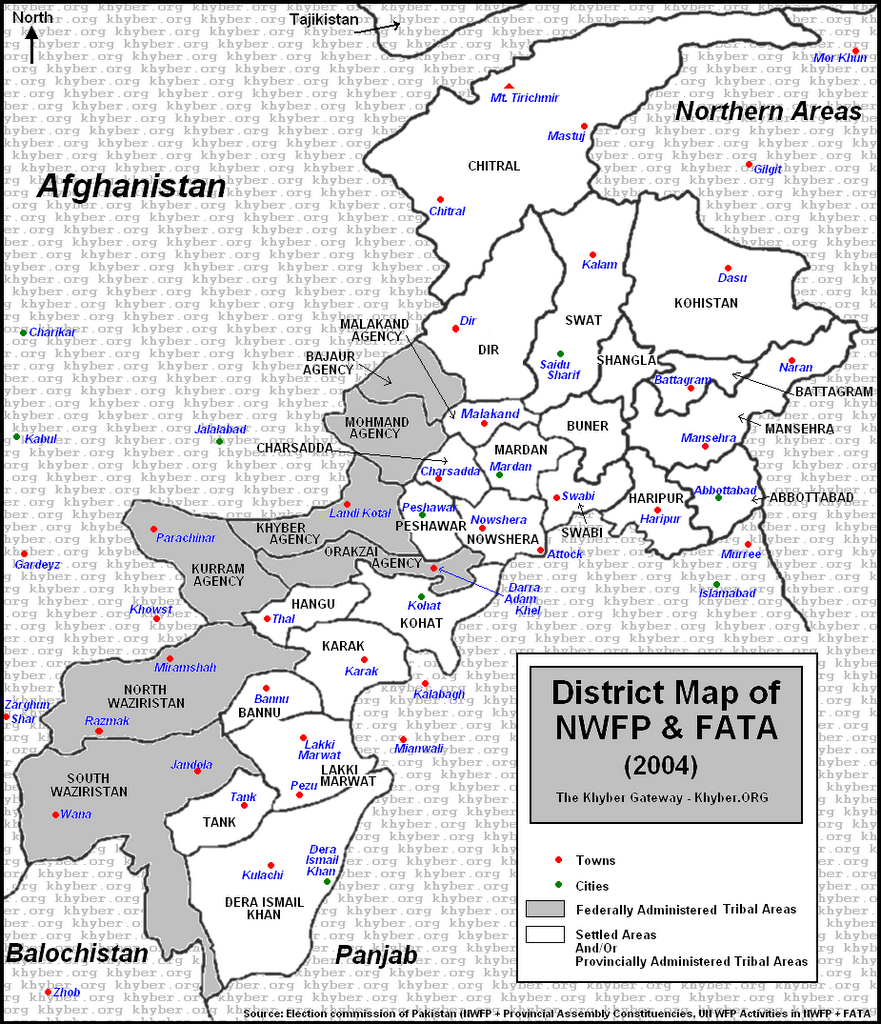
Pakistan's Chitral District: A Refuge for al-Qaeda's Top Leadership?
By Hassan Abbas
Terrorism Focus - Jamestown Foundation
Volume 3, Issue 46 (November 28, 2006)
In the hunt for Osama bin Laden and other top al-Qaeda leaders, security services continue to focus on Pakistan's Chitral district in the North-West Frontier Province (NWFP). Chitral became a concern after the release of a bin Laden videotape from September 2003 in which trees native to the Chitrali mountain range were evident. Extensive search operations for the al-Qaeda leader and fellow operatives by Pakistani and U.S. forces were conducted in the area in February-March 2003 (Dawn, March 7, 2003). More recently, in May there were claims that the Federal Bureau of Investigation had established an office in Chitral to monitor militant activities in the district (The Nation, May 1). Other links to the district include Abu Khabaib, an Arab explosives expert who has been spotted several times in the hills of Chitral. He is known to have helped Sheikh Ahmed Saleem, an Arab member of al-Qaeda. Saleem has been giving money to Lashkar-e-Jhangvi for recruiting militants for al-Qaeda in Pakistan (Daily Times, October 2). Finally, because Chitral is adjacent to Afghanistan's Nuristan province, there is concern that Taliban and al-Qaeda militants are crossing the border between the two countries.
Chitral, with its rich cultural heritage and changing religio-political trends, is a fascinating area in the NWFP. It is caught between diverse traditions and rumors of al-Qaeda involvement. In the backdrop of the turmoil created by pro-Taliban elements in the Pakistan-Afghanistan border area and the rising influence of religious political parties in the district, Chitral has become an important focus in the war on terrorism. For centuries, the people of Chitral have lived in relative isolation in their mountain kingdom. They have experienced various political phases, beginning with their involuntary association with the British Empire (1895), their voluntary association with the new state of Pakistan (1947) and finally their incorporation into Pakistan's NWFP (1969). The Katur dynasty that ruled the area collapsed in 1949-50, and the federal government of Pakistan took direct control of the Chitral administration.
Geographically, Chitral is bordered by Afghanistan in the north, south and west. A narrow strip of Afghan territory, the Wakhan strip, separates it from Tajikistan. It has always been a very important route for invaders on their way to South Asia, including Alexander the Great and the Mongols. The Chitral Valley, at an elevation of 1,100 meters, is popular with mountaineers, hunters, hikers and Western anthropologists. Imposing mountains dominate the landscape of Chitral, forging a rugged terrain that is home to approximately 325,000 people comprising an area of 243,818 acres. The topography of the district is varied, with 30% of the region covered in glaciers, snow-clad mountains, bare rock and barren ground, and with about 65% of the land supporting pastures with only sparse vegetation. Chitral is cut off from the rest of Pakistan during the winter. Sunnis compose 65% of Chitral, while Ismaili Shiites comprise 35% of the population. A small population of the non-Muslim Kailash community—known for their beautiful dresses and traditional dance—are based in the south of the district.
While located in a Pashtun region, the Chitrali people are ethnically different than Pashtuns. They are called Kho and their primary language is Khowar, although about 10 other languages are spoken in the area. One might expect that Pashto would be a natural choice as a second language for many Chitralis, but that is not the case. In fact, Chitralis dislike Pashtuns and their language. Their dislike is in part an outcome of economic factors—for instance, since 1979-80, a large number of Afghan refugees (predominantly Pashtuns) moved into the area and competed quite successfully with the local Chitrali businessmen. Business in the region is predominately agricultural.
Chitralis have a reputation for being civilized and peace-loving. Their folk singers are popular in various parts of Pakistan. There is a fairly sizeable seasonal migration of Chitrali men to Peshawar and to other cities of Pakistan for winter employment. Additionally, many have found employment in the Gulf States. Relations between Sunnis and Shiite Ismailis have been cordial historically, but have recently become more heated now that Wahhabis have more influence in the area.
In terms of political orientation, however, Chitral has been steadily becoming more conservative. For instance, its current representative in the National Assembly of Pakistan, Maulana Abdul Akbar Chitrali, belongs to Jamaat-e-Islami (part of the religious MMA alliance) and is a chief administrator of a seminary in Peshawar named Jamia Arabia Hadiqatul Uloom. Interestingly, he is best known for leading a mob that burned down the offices of the Frontier Post newspaper in Peshawar three years ago after it published a "Letter to the Editor" with controversial religious connotations.
More troubling signs emerged in late 2004 when the offices of a progressive Pakistani NGO, Aga Khan Rural Support Program (AKRSP), sponsored by Ismaili leader Prince Karim Aga Khan, were attacked by religious extremists. Developments came to a head on December 27, 2004 when two workers of the Aga Khan Health Services Office in Chitral were killed in a terrorist attack and four vehicles owned by the charity organization were destroyed. The culprits turned out to be two men associated with the declared terrorist group Lashkar-e-Jhangvi, which has links to al-Qaeda (Dawn, January 5, 2005). In a December 29, 2004 Daily Times editorial titled "Chitral Trouble is Symptomatic of Deeper Malaise," the paper maintained that this development was an outcome of sectarianism and that "in Chitral, the Shiite-Sunni tension dates back to 1988 when the Northern Areas were attacked by Pashtun lashkars."
In conclusion, due to Chitral's location on the border with Afghanistan, elements of al-Qaeda may find refuge there. The mountains potentially provide a good cover. Yet, another potent factor has to be kept in perspective—because much of the district's population is not friendly to Pashtuns, they may be less willing than other areas of the NWFP to provide sanctuary. Pashtunwali has very limited appeal in this area and Ismaili Shiites (35% of the population) are anti-al-Qaeda to their core for sectarian reasons. Therefore, one can speculate that the al-Qaeda leadership may have passed through this area during their "travels" in the region, but are unlikely to consider Chitral a place where they can find safe refuge for a long period of time.
Thursday, May 10, 2007
Politics of Hezbollah
Hezbollah Reacts to Israel's Winograd Report
By Chris Zambelis
Terrorism Focus: Jamestown Foundation; May 8, 2007
Israel's recent release of the preliminary findings of the Winograd Commission, an independent government-appointed initiative led by former judge Eliyahu Winograd that was convened to investigate Israel's failures in its summer 2006 war against Hezbollah in Lebanon, may spell the political demise of Israeli Prime Minister Ehud Olmert (Haaretz, May 1). In contrast, Hezbollah was quick to use the findings of the report to bolster its claims of victory over the vastly superior Israeli military and to criticize the Lebanese government's handling of the conflict. Hezbollah also harnessed the opportunity to enhance its Lebanese and Arab nationalist credentials and claims to represent a force for legitimate resistance in the face of growing pressure from Israel and Sunni-led regimes closely aligned with the United States. Egypt, Jordan and Saudi Arabia, among others, label the group as a destabilizing force and an instrument of Iranian Shiite militancy.
In a May 2 statement at the second annual Arab and International Book Fair hosted by the Education Association "Islamic Maaref" in Beirut's southern suburbs of Dahiyeh, an impoverished area populated primarily by Shiite Muslims and a bastion of Hezbollah support, Hezbollah Secretary General Hassan Nasrallah went so far as to praise Israel for acknowledging what the Winograd Commission labels as its numerous "failures": "It is worthy of respect that an investigative commission appointed by Olmert condemns Olmert…We respect that political and popular powers swiftly moved to save their country, while unfortunately in Lebanon, neither an investigation was made nor a probing panel was formed…The Winograd Commission was faithful to 'Israel's' existence, they are ready to sacrifice one hundred Olmerts for [Israel's] survival" (http://www.moqawama.org).
Nasrallah also used the opportunity to juxtapose Israel's Winograd Commission with the reaction of Lebanese and regional Arab leaders to last summer's crisis. He highlighted the disconnect between the majority of Arabs and Muslims who view Hezbollah in a favorable light and a source of pride and their ruling regimes who perceive the group as a threat: "They [Israel] study their defeat in order to learn from it…Sadly, we wait for an 'Israeli' commission to tell us we have won." He used the occasion of the book fair to criticize regional governments for their incompetence and lack of accountability and to praise the virtues of education, knowledge and free thought as key pillars of popular resistance and independence: "When there is an independent people, independent in their thought, will and ability to survive…they can be their own masters and they can be free…We have become the richest nation in the world, yet the most illiterate, subordinate and ignorant nation at a time when we have every resource we need" (http://www.moqawama.org).
Despite reports of a growing Sunni-Shiite sectarian divide in the Middle East and anti-Shiite sentiments among the most extreme fringes of Sunni militancy, the majority of Arab and Sunni Muslim public opinion holds Hezbollah in high esteem for its successful struggle against Israeli occupation in the past and impressive performance on the battlefield during the 2006 war. Hezbollah is also widely viewed as a Lebanese and Arab nationalist force, regardless of its Shiite Islamist pedigree and ties to Iran. In contrast, incumbent U.S.-backed autocratic regimes in Egypt, Jordan and Saudi Arabia fear Hezbollah's ability to galvanize local populations and inspire dissent among those opposed to their rule. By praising Israel's decision to scrutinize the performance of its leadership publicly, Nasrallah is in effect highlighting the shortcomings of the incumbent leaders in Beirut, Cairo, Amman and Riyadh. This bolsters the group's standing among Arabs and Muslims across the region, as well as in the context of Lebanon's ongoing internal political struggle.
By Chris Zambelis
Terrorism Focus: Jamestown Foundation; May 8, 2007
Israel's recent release of the preliminary findings of the Winograd Commission, an independent government-appointed initiative led by former judge Eliyahu Winograd that was convened to investigate Israel's failures in its summer 2006 war against Hezbollah in Lebanon, may spell the political demise of Israeli Prime Minister Ehud Olmert (Haaretz, May 1). In contrast, Hezbollah was quick to use the findings of the report to bolster its claims of victory over the vastly superior Israeli military and to criticize the Lebanese government's handling of the conflict. Hezbollah also harnessed the opportunity to enhance its Lebanese and Arab nationalist credentials and claims to represent a force for legitimate resistance in the face of growing pressure from Israel and Sunni-led regimes closely aligned with the United States. Egypt, Jordan and Saudi Arabia, among others, label the group as a destabilizing force and an instrument of Iranian Shiite militancy.
In a May 2 statement at the second annual Arab and International Book Fair hosted by the Education Association "Islamic Maaref" in Beirut's southern suburbs of Dahiyeh, an impoverished area populated primarily by Shiite Muslims and a bastion of Hezbollah support, Hezbollah Secretary General Hassan Nasrallah went so far as to praise Israel for acknowledging what the Winograd Commission labels as its numerous "failures": "It is worthy of respect that an investigative commission appointed by Olmert condemns Olmert…We respect that political and popular powers swiftly moved to save their country, while unfortunately in Lebanon, neither an investigation was made nor a probing panel was formed…The Winograd Commission was faithful to 'Israel's' existence, they are ready to sacrifice one hundred Olmerts for [Israel's] survival" (http://www.moqawama.org).
Nasrallah also used the opportunity to juxtapose Israel's Winograd Commission with the reaction of Lebanese and regional Arab leaders to last summer's crisis. He highlighted the disconnect between the majority of Arabs and Muslims who view Hezbollah in a favorable light and a source of pride and their ruling regimes who perceive the group as a threat: "They [Israel] study their defeat in order to learn from it…Sadly, we wait for an 'Israeli' commission to tell us we have won." He used the occasion of the book fair to criticize regional governments for their incompetence and lack of accountability and to praise the virtues of education, knowledge and free thought as key pillars of popular resistance and independence: "When there is an independent people, independent in their thought, will and ability to survive…they can be their own masters and they can be free…We have become the richest nation in the world, yet the most illiterate, subordinate and ignorant nation at a time when we have every resource we need" (http://www.moqawama.org).
Despite reports of a growing Sunni-Shiite sectarian divide in the Middle East and anti-Shiite sentiments among the most extreme fringes of Sunni militancy, the majority of Arab and Sunni Muslim public opinion holds Hezbollah in high esteem for its successful struggle against Israeli occupation in the past and impressive performance on the battlefield during the 2006 war. Hezbollah is also widely viewed as a Lebanese and Arab nationalist force, regardless of its Shiite Islamist pedigree and ties to Iran. In contrast, incumbent U.S.-backed autocratic regimes in Egypt, Jordan and Saudi Arabia fear Hezbollah's ability to galvanize local populations and inspire dissent among those opposed to their rule. By praising Israel's decision to scrutinize the performance of its leadership publicly, Nasrallah is in effect highlighting the shortcomings of the incumbent leaders in Beirut, Cairo, Amman and Riyadh. This bolsters the group's standing among Arabs and Muslims across the region, as well as in the context of Lebanon's ongoing internal political struggle.
Thursday, February 04, 2010
Training Afghan Police: A Failing Project?
With Raw Recruits, Afghan Police Buildup Falters
By ROD NORDLAND, February 2, 2010, New York Times
KABUL, Afghanistan — The NATO general in charge of training the Afghan police has some tongue-in-cheek career advice for the country’s recruits.
“It’s better to join the Taliban; they pay more money,” said Brig. Gen. Carmelo Burgio, from Italy’s paramilitary Carabinieri force.
That sardonic view reflects a sobering reality. The attempts to build a credible Afghan police force are faltering badly even as officials acknowledge that the force will be a crucial piece of the effort to have Afghans manage their own security so American forces can begin leaving next year.
Though they have revamped the program recently and put it under new leadership, Afghan, NATO and American officials involved in the training effort list a daunting array of challenges, as familiar as they are intractable.
One in five recruits tests positive for drugs, while fewer than one in 10 can read and write — a rate even lower than the Afghan norm of 15 percent literacy. Many cannot even read a license plate number. Taliban infiltration is a constant worry; incompetence an even bigger one.
After eight weeks of training, an average of 5 percent of recruits cannot pass firearms tests — but are given a gun and sent out to duty. Unsurprisingly, the Afghan National Police have the highest casualty rates of all the security forces fighting the Taliban; 646 died last year, compared with 282 Afghan Army soldiers and 388 NATO troops, according to NATO figures.
The death rate, poor pay and lack of equipment are among the reasons that a fourth of the officers quit every year, making the Afghan government’s lofty goals of substantially building up the police force even harder to achieve.
For complete article, click here
Related:
Training of Afghan Police by Europe Is Found Lacking - NYT
U.S. plans major Afghan police boost - Holbrooke
Can Afghanistan’s New “Guardian” Militia Restore Security in the Provinces? - Jamestown Foundation
Interagency assessment of Afghanistan Police Training and Readiness - Inspectors General of US DOD and DOS - 2006
By ROD NORDLAND, February 2, 2010, New York Times
KABUL, Afghanistan — The NATO general in charge of training the Afghan police has some tongue-in-cheek career advice for the country’s recruits.
“It’s better to join the Taliban; they pay more money,” said Brig. Gen. Carmelo Burgio, from Italy’s paramilitary Carabinieri force.
That sardonic view reflects a sobering reality. The attempts to build a credible Afghan police force are faltering badly even as officials acknowledge that the force will be a crucial piece of the effort to have Afghans manage their own security so American forces can begin leaving next year.
Though they have revamped the program recently and put it under new leadership, Afghan, NATO and American officials involved in the training effort list a daunting array of challenges, as familiar as they are intractable.
One in five recruits tests positive for drugs, while fewer than one in 10 can read and write — a rate even lower than the Afghan norm of 15 percent literacy. Many cannot even read a license plate number. Taliban infiltration is a constant worry; incompetence an even bigger one.
After eight weeks of training, an average of 5 percent of recruits cannot pass firearms tests — but are given a gun and sent out to duty. Unsurprisingly, the Afghan National Police have the highest casualty rates of all the security forces fighting the Taliban; 646 died last year, compared with 282 Afghan Army soldiers and 388 NATO troops, according to NATO figures.
The death rate, poor pay and lack of equipment are among the reasons that a fourth of the officers quit every year, making the Afghan government’s lofty goals of substantially building up the police force even harder to achieve.
For complete article, click here
Related:
Training of Afghan Police by Europe Is Found Lacking - NYT
U.S. plans major Afghan police boost - Holbrooke
Can Afghanistan’s New “Guardian” Militia Restore Security in the Provinces? - Jamestown Foundation
Interagency assessment of Afghanistan Police Training and Readiness - Inspectors General of US DOD and DOS - 2006
Thursday, October 02, 2008
Baitullah Mehsud Dead?
Taliban leader in Pakistan, Baitullah Mehsud, 'dies from kidney failure'
Speculation is mounting that Baitullah Mehsud, the leader of the Pakistani wing of the Taliban, has died from kidney failure
By Isambard Wilkinson in Islamabad
Telegraph, UK: 01 Oct 2008
Mehsud was accused by Pakistan and US intelligence of being responsible for the assassination of the former prime minister, Benazir Bhutto.
Rumours of his death are circulating in Pakistan. The former fitness instructor turned terrorist leader has diabetes and has been reported to be unwell for months.
Mehsud, in his mid-thirties, rose suddenly from obscurity possibly with the support of a faction of Pakistan's shadowy ISI military intelligence that has secretly backed the Taliban.
However, his doctor said he had an unspecified kidney problem, but that he was alive.
Mehsud has denied involvement in the attack on Bhutto as she left an election rally in the city of Rawalpindi on Dec. 27, which her widower, Mr Zardari, has blamed on Pakistan's establishment.
Officials have accused Mehsud, the head of the country's umbrella Taliban organisation, Tehreek-e-Taliban Pakistan (TTP), of being behind a wave of suicide attacks in Pakistan since the middle of last year.
Mixed reports surrounding the Taliban leader's death came as American missiles, fired from an unmanned drone aircraft, killed at least six people in a Pakistani tribal region near the Afghan border.
The missiles struck the home of a local Taliban commander before midnight on Tuesday near Mir Ali, a town in North Waziristan.
"We have reports of five dead including foreign militants," said an intelligence official.
The strike took place shortly after tribesmen shot at three drones circling the village of Khusali Toorikhel in North Waziristan, a known haunt of Taliban and Al-Qaeda militants.
Tension between Pakistan and the United States has escalated since Washington stepped up attacks on Pakistani territory after a new civilian government came to power in March.
American forces have carried out seven missile strikes fired from pilotless drones and a commando raid on the Pakistani side of the border in the past month.
Last Thursday, Pakistani and US troops exchanged fire along the border after two US military helicopters came under fire.
Though both sides played down the incident later, Pakistan contended that the US helicopters had entered Pakistani territory while Washington argued they had not left Afghanistan.
America has expressed frustration at the continued support for the Taliban by Pakistan's military intelligence agency.
On Tuesday the Afghan head of intelligence told Al Jazeera news broadcaster that Pakistan did not need a military operation to tackle the Taliban but only to "soft knock their houses" in the Pakistani cities of Quetta and Peshawar.
President Asif Ali Zardari has vowed zero tolerance against violations of Pakistan's sovereignty.
Washington claimed to respect Pakistani sovereignty on Monday in a joint statement with Pakistan following talks between the US deputy secretary of state, John Negroponte, and Pakistan's Foreign Minister Shah Mehmood Qureshi.
"The United States affirmed its support for Pakistan's sovereignty, independence, unity, and territorial integrity," according to the joint statement issued by the State Department.
However, it is believed that a secret deal exists permitting missile strikes against foreign fighters.
The former foreign minister, Khurshid Kasuri, revealed at the weekend that a deal allowed for "limited" American action on Pakistani soil.
Also see:
Top Pakistan militant 'not dead' - BBC
Profile of Baitullah Mehsud - BBC
Baitullah Mehsud: South Waziristan's Unofficial Amir - Jamestown Foundation
Pakistani Taliban leader Mehsud seriously ill: officials, militants - AFP
LATEST UPDATE:
Mehsud visits parts of S.Waziristan
The News, Updated at: 2050 PST, Thursday, October 02, 2008
WANA: Supreme commander of the banned outfit Tehreek-i-Taliban Pakistan, Baitullah Mehsud visited different area of South Waziristan on Thursday.
According to Taliban sources, Meshsud visited Makeen, Ladha, Badar, Salay Rogha and other areas.
The tribesmen upon seeing the Taliban commander, fired their guns in the air.
President Tehreek-i-Insaf South Waziristan, Toofan Burki garlanded Baitullah Mehsud and put traditional Pagri (turban) upon his head.
Speaking on the occasion, the speakers said the electronic media is airing news regarding the death of Baitullah Mehsud, causing concern among the tribesmen.
Therefore, the tribal elders decided that Mehsud should undertake visit of the tribal areas so that people could see him.
Speculation is mounting that Baitullah Mehsud, the leader of the Pakistani wing of the Taliban, has died from kidney failure
By Isambard Wilkinson in Islamabad
Telegraph, UK: 01 Oct 2008
Mehsud was accused by Pakistan and US intelligence of being responsible for the assassination of the former prime minister, Benazir Bhutto.
Rumours of his death are circulating in Pakistan. The former fitness instructor turned terrorist leader has diabetes and has been reported to be unwell for months.
Mehsud, in his mid-thirties, rose suddenly from obscurity possibly with the support of a faction of Pakistan's shadowy ISI military intelligence that has secretly backed the Taliban.
However, his doctor said he had an unspecified kidney problem, but that he was alive.
Mehsud has denied involvement in the attack on Bhutto as she left an election rally in the city of Rawalpindi on Dec. 27, which her widower, Mr Zardari, has blamed on Pakistan's establishment.
Officials have accused Mehsud, the head of the country's umbrella Taliban organisation, Tehreek-e-Taliban Pakistan (TTP), of being behind a wave of suicide attacks in Pakistan since the middle of last year.
Mixed reports surrounding the Taliban leader's death came as American missiles, fired from an unmanned drone aircraft, killed at least six people in a Pakistani tribal region near the Afghan border.
The missiles struck the home of a local Taliban commander before midnight on Tuesday near Mir Ali, a town in North Waziristan.
"We have reports of five dead including foreign militants," said an intelligence official.
The strike took place shortly after tribesmen shot at three drones circling the village of Khusali Toorikhel in North Waziristan, a known haunt of Taliban and Al-Qaeda militants.
Tension between Pakistan and the United States has escalated since Washington stepped up attacks on Pakistani territory after a new civilian government came to power in March.
American forces have carried out seven missile strikes fired from pilotless drones and a commando raid on the Pakistani side of the border in the past month.
Last Thursday, Pakistani and US troops exchanged fire along the border after two US military helicopters came under fire.
Though both sides played down the incident later, Pakistan contended that the US helicopters had entered Pakistani territory while Washington argued they had not left Afghanistan.
America has expressed frustration at the continued support for the Taliban by Pakistan's military intelligence agency.
On Tuesday the Afghan head of intelligence told Al Jazeera news broadcaster that Pakistan did not need a military operation to tackle the Taliban but only to "soft knock their houses" in the Pakistani cities of Quetta and Peshawar.
President Asif Ali Zardari has vowed zero tolerance against violations of Pakistan's sovereignty.
Washington claimed to respect Pakistani sovereignty on Monday in a joint statement with Pakistan following talks between the US deputy secretary of state, John Negroponte, and Pakistan's Foreign Minister Shah Mehmood Qureshi.
"The United States affirmed its support for Pakistan's sovereignty, independence, unity, and territorial integrity," according to the joint statement issued by the State Department.
However, it is believed that a secret deal exists permitting missile strikes against foreign fighters.
The former foreign minister, Khurshid Kasuri, revealed at the weekend that a deal allowed for "limited" American action on Pakistani soil.
Also see:
Top Pakistan militant 'not dead' - BBC
Profile of Baitullah Mehsud - BBC
Baitullah Mehsud: South Waziristan's Unofficial Amir - Jamestown Foundation
Pakistani Taliban leader Mehsud seriously ill: officials, militants - AFP
LATEST UPDATE:
Mehsud visits parts of S.Waziristan
The News, Updated at: 2050 PST, Thursday, October 02, 2008
WANA: Supreme commander of the banned outfit Tehreek-i-Taliban Pakistan, Baitullah Mehsud visited different area of South Waziristan on Thursday.
According to Taliban sources, Meshsud visited Makeen, Ladha, Badar, Salay Rogha and other areas.
The tribesmen upon seeing the Taliban commander, fired their guns in the air.
President Tehreek-i-Insaf South Waziristan, Toofan Burki garlanded Baitullah Mehsud and put traditional Pagri (turban) upon his head.
Speaking on the occasion, the speakers said the electronic media is airing news regarding the death of Baitullah Mehsud, causing concern among the tribesmen.
Therefore, the tribal elders decided that Mehsud should undertake visit of the tribal areas so that people could see him.
Wednesday, February 13, 2008
The Impact of Pashtun Tribal Differences on the Pakistani Taliban
The Impact of Pashtun Tribal Differences on the Pakistani Taliban
By Rahimullah Yusufzai, Terrorism Monitor, Jamestown Foundation, Volume 6, Issue 3 (February 7, 2008)
Though members of militant Islamic groups such as the Pakistani Taliban and other jihadis have almost the same anti-United States and pro-al-Qaeda worldview, they are not especially disciplined when it comes to organizational matters. Difficulty in this area explains the existence of so many extremist factions operating under different leaders and commanders who sometimes express conflicting opinions on domestic and international issues.
The formation of an umbrella organization, Tehrek-e-Taliban-Pakistan (Movement of Pakistani Taliban, or TTP) on December 14, 2007, was meant to bring the different Taliban groups operating in the North-West Frontier Province (NWFP) into one formation and improve their coordination (The News International [Islamabad], December 15, 2007). Its spokesman, Maulvi Omar, a shadowy figure using a fake name, claimed that 27 Taliban factions operating in the Federally Administered Tribal Areas (FATA) were part of the movement. Nobody was surprised when Baitullah Mehsud, amir of the Taliban in the territory populated by the Mehsud Pashtun tribe in South Waziristan, was named as leader of the TTP. He was the most powerful among the Pakistani Taliban commanders and it was natural that he would lead the organization.
Tribal Nature of the Pakistani Taliban
The tribal nature of some of the Taliban groups soon became evident when militants in North Waziristan warned the Mehsud-led Taliban in neighboring South Waziristan not to launch attacks against the Pakistan Army in their part of the tribal region (The News International, January 30). The warning came from Hafiz Gul Bahadur, the amir of the Taliban in North Waziristan, despite the fact that he was earlier named deputy to Mehsud in the Tehrek-e-Taliban-Pakistan. Association with the TTP and being its deputy leader did not mean much when it came to the territorial and tribal limits of each Taliban group and commander. Hafiz Gul Bahadur was particularly furious when Mehsud’s men started firing rockets into the army’s camp at Razmak, a town in North Waziristan, during the recent fighting between the military and the Mehsud-commanded militants.
It was also evident that Hafiz Gul Bahadur and his Taliban fighters failed to abide by one of the major decisions of the TTP by refusing to coordinate attacks on the security forces in North Waziristan to help ease pressure on the Taliban fighting under Mehsud’s command in South Waziristan. This failure defied a Taliban decision that every Taliban group was required to come to the assistance of others in its area of operation that were under attack from the Pakistan Army. As part of that policy, a Taliban group in the semi-tribal area of Darra Adamkhel seized five military trucks packed with ammunition and supplies for the troops in South Waziristan. The attack triggered fighting in the gun-manufacturing town in a bid to overstretch the resources of the Pakistan Army (Dawn [Islamabad], January 26). Taliban factions in Mohmand, Bajaur and Orakzai tribal regions and also in the Swat district of the NWFP launched attacks against the security forces during this period as part of a strategy to ease military pressure on Mehsud and his men. But instead of launching attacks on the military, the Taliban fighters in North Waziristan announced an extension of their unilateral ceasefire with the government and even issued a warning to Mehsud to stay out of their territory. One reason the North Waziristan militants stayed out of the conflict in South Waziristan was the fact that they belonged to different Pashtun tribes; Taliban commander Baitullah Mehsud belongs to the Mehsud tribe, while Hafiz Gul Bahadur and others in his group belong to the Torikhel Wazir and Daur tribes.
Command Structure in the Pakistani Taliban
The lack of coordination between the Taliban factions in South Waziristan and North Waziristan also showed that the TTP had yet to attain unity in the ranks of the militants operating in different tribal regions and districts. On paper, the TTP looks impressive, with powerful components in all seven tribal agencies and in most of the six semi-tribal Frontier Regions and several settled districts of the NWFP. Its command structure also appears strong, with representatives from tribal regions and districts where the militants had fought the army to a standstill or forced the government to deploy large numbers of troops to secure the area. Led by Mehsud from South Waziristan, the TTP’s deputy leader Hafiz Gul Bahadur belongs to North Waziristan and the second deputy head, Maulana Faqir Muhammad, is from Bajaur. Taliban groups in Swat and elsewhere are also represented on the TTP’s 40-member decision-making shura (consultative council). However, these groups also have regional and local political agendas and are, therefore, under pressure from their tribes and communities not to become involved in wider conflicts that could transform their areas into battlegrounds and contribute to their suffering.
A case study of Baitullah Mehsud’s leadership in South Waziristan would be instructive in understanding the tribal influences that impede unity among Taliban factions in FATA. As a Mehsud tribesman, he cannot freely operate in the Wana area, which is inhabited by the Ahmadzai Wazir tribe, even though both the tribes live side by side in South Waziristan and are almost equally affected by Talibanization. Past rivalries have kept the Ahmadzai Wazir and Mehsud tribes apart, and their relations to this day are uneasy and uncertain. As a consequence, Taliban members belonging to the two tribes maintained separate command structures to avoid friction and prevent tribal animosities from poisoning their relations. The Taliban among the Ahmadzai Wazir tribe thus functioned independently of commander Mehsud, first under the command of the late Nek Muhammad and then Haji Omar, Noor Islam, Maulvi Muhammad Abbas, Javed Karmazkhel and Maulvi Aziz. Last April, a split occurred among these Taliban commanders, with Maulvi Muhammad Nazir and Haji Hannan ousting Haji Omar and his allies for offering protection to foreign militants from Uzbekistan and other countries and accepting arms and money from the Pakistan Army. The Taliban in Wana have thus parted ways on the issue of supporting or opposing the presence in their area of Uzbek militants aligned with the Islamic Movement of Uzbekistan (IMU) (The News International, January 26). In fact, tribal animosities have also influenced the decision of some Taliban fighters to join one or the other side on this issue. Haji Omar and Maulvi Nazir belong to different sub-tribes of the Ahmadzai Wazir tribe and this was a factor in pushing them into rival Taliban camps.
It would also be wrong to assume that all Mehsud clans and tribesmen support Taliban commander Baitullah Mehsud. Many blame him for bringing suffering on the tribe and making their villages a battleground for the military and the militants. However, they cannot speak out against him due to fear of reprisal. The Mehsuds living outside their tribal homes in South Waziristan are relatively free to express their opinion about the Taliban commander, though they must be careful because Mehsud has followers and informants even in places like Tank and Dera Ismail Khan, where Mehsud families have migrated and become largely urbanized. The Shabikhel sub-tribe of the Mehsud is apparently proud of Baitullah because he is one of their own, but other clans do not have that kind of bond with the Taliban leader. Tribal affinities are fairly strong in Waziristan and it is common for members of a tribe to become closer in the event of a dispute with other tribes.
Factionalism in Waziristan and Bajaur
On occasion, there are reports that Taliban commanders and the rank and file in North Waziristan have developed differences on certain issues and split into factions comprising members from the Torikhel Wazir and Daur tribes. There are also signs that the local Taliban have evolved into Miramshah and Mir Ali factions, named after the two major towns in North Waziristan. The Mir Ali group often complains that their area has suffered greater damage as a result of militants’ attacks and retaliatory military strikes than Miramshah, which is the headquarters of North Waziristan and is better defended by government security forces.
In the Bajaur tribal region, the Taliban militants are mainly concentrated in the Mamond area, which is on the border of Afghanistan’s eastern Kunar province. The top Taliban commander in Bajaur, Maulana Faqir Muhammad, also belonged to Mamond, as did his deputy Maulana Liaquat Ali, who was killed in a U.S. missile strike on an Islamic school in Chingai village on October 30, 2006 (The Nation [Pakistan], October 31, 2006). The Taliban influence has only marginally spread to other parts of Bajaur.
There is no denying the fact that tribal affiliations play a major role in the formation of Taliban groups and the choice of commanders. The Taliban and other jihad advocates often claim that they believe in the concept of a common Muslim ummah (community) and reject the division of their religion into groups based on ethnicity, language, geographical borders and tribes. In practice this is easier said than done. In tribal societies such as that of the Pashtuns inhabiting Pakistan and Afghanistan, even ideologically-driven radical Taliban and jihadist fighters gravitate toward their own tribe and local commander whether fighting U.S.-led Coalition forces or the armed forces of Pakistan.
Also See: Taliban find fertile new ground in Pakistan By Imtiaz Ali
By Rahimullah Yusufzai, Terrorism Monitor, Jamestown Foundation, Volume 6, Issue 3 (February 7, 2008)
Though members of militant Islamic groups such as the Pakistani Taliban and other jihadis have almost the same anti-United States and pro-al-Qaeda worldview, they are not especially disciplined when it comes to organizational matters. Difficulty in this area explains the existence of so many extremist factions operating under different leaders and commanders who sometimes express conflicting opinions on domestic and international issues.
The formation of an umbrella organization, Tehrek-e-Taliban-Pakistan (Movement of Pakistani Taliban, or TTP) on December 14, 2007, was meant to bring the different Taliban groups operating in the North-West Frontier Province (NWFP) into one formation and improve their coordination (The News International [Islamabad], December 15, 2007). Its spokesman, Maulvi Omar, a shadowy figure using a fake name, claimed that 27 Taliban factions operating in the Federally Administered Tribal Areas (FATA) were part of the movement. Nobody was surprised when Baitullah Mehsud, amir of the Taliban in the territory populated by the Mehsud Pashtun tribe in South Waziristan, was named as leader of the TTP. He was the most powerful among the Pakistani Taliban commanders and it was natural that he would lead the organization.
Tribal Nature of the Pakistani Taliban
The tribal nature of some of the Taliban groups soon became evident when militants in North Waziristan warned the Mehsud-led Taliban in neighboring South Waziristan not to launch attacks against the Pakistan Army in their part of the tribal region (The News International, January 30). The warning came from Hafiz Gul Bahadur, the amir of the Taliban in North Waziristan, despite the fact that he was earlier named deputy to Mehsud in the Tehrek-e-Taliban-Pakistan. Association with the TTP and being its deputy leader did not mean much when it came to the territorial and tribal limits of each Taliban group and commander. Hafiz Gul Bahadur was particularly furious when Mehsud’s men started firing rockets into the army’s camp at Razmak, a town in North Waziristan, during the recent fighting between the military and the Mehsud-commanded militants.
It was also evident that Hafiz Gul Bahadur and his Taliban fighters failed to abide by one of the major decisions of the TTP by refusing to coordinate attacks on the security forces in North Waziristan to help ease pressure on the Taliban fighting under Mehsud’s command in South Waziristan. This failure defied a Taliban decision that every Taliban group was required to come to the assistance of others in its area of operation that were under attack from the Pakistan Army. As part of that policy, a Taliban group in the semi-tribal area of Darra Adamkhel seized five military trucks packed with ammunition and supplies for the troops in South Waziristan. The attack triggered fighting in the gun-manufacturing town in a bid to overstretch the resources of the Pakistan Army (Dawn [Islamabad], January 26). Taliban factions in Mohmand, Bajaur and Orakzai tribal regions and also in the Swat district of the NWFP launched attacks against the security forces during this period as part of a strategy to ease military pressure on Mehsud and his men. But instead of launching attacks on the military, the Taliban fighters in North Waziristan announced an extension of their unilateral ceasefire with the government and even issued a warning to Mehsud to stay out of their territory. One reason the North Waziristan militants stayed out of the conflict in South Waziristan was the fact that they belonged to different Pashtun tribes; Taliban commander Baitullah Mehsud belongs to the Mehsud tribe, while Hafiz Gul Bahadur and others in his group belong to the Torikhel Wazir and Daur tribes.
Command Structure in the Pakistani Taliban
The lack of coordination between the Taliban factions in South Waziristan and North Waziristan also showed that the TTP had yet to attain unity in the ranks of the militants operating in different tribal regions and districts. On paper, the TTP looks impressive, with powerful components in all seven tribal agencies and in most of the six semi-tribal Frontier Regions and several settled districts of the NWFP. Its command structure also appears strong, with representatives from tribal regions and districts where the militants had fought the army to a standstill or forced the government to deploy large numbers of troops to secure the area. Led by Mehsud from South Waziristan, the TTP’s deputy leader Hafiz Gul Bahadur belongs to North Waziristan and the second deputy head, Maulana Faqir Muhammad, is from Bajaur. Taliban groups in Swat and elsewhere are also represented on the TTP’s 40-member decision-making shura (consultative council). However, these groups also have regional and local political agendas and are, therefore, under pressure from their tribes and communities not to become involved in wider conflicts that could transform their areas into battlegrounds and contribute to their suffering.
A case study of Baitullah Mehsud’s leadership in South Waziristan would be instructive in understanding the tribal influences that impede unity among Taliban factions in FATA. As a Mehsud tribesman, he cannot freely operate in the Wana area, which is inhabited by the Ahmadzai Wazir tribe, even though both the tribes live side by side in South Waziristan and are almost equally affected by Talibanization. Past rivalries have kept the Ahmadzai Wazir and Mehsud tribes apart, and their relations to this day are uneasy and uncertain. As a consequence, Taliban members belonging to the two tribes maintained separate command structures to avoid friction and prevent tribal animosities from poisoning their relations. The Taliban among the Ahmadzai Wazir tribe thus functioned independently of commander Mehsud, first under the command of the late Nek Muhammad and then Haji Omar, Noor Islam, Maulvi Muhammad Abbas, Javed Karmazkhel and Maulvi Aziz. Last April, a split occurred among these Taliban commanders, with Maulvi Muhammad Nazir and Haji Hannan ousting Haji Omar and his allies for offering protection to foreign militants from Uzbekistan and other countries and accepting arms and money from the Pakistan Army. The Taliban in Wana have thus parted ways on the issue of supporting or opposing the presence in their area of Uzbek militants aligned with the Islamic Movement of Uzbekistan (IMU) (The News International, January 26). In fact, tribal animosities have also influenced the decision of some Taliban fighters to join one or the other side on this issue. Haji Omar and Maulvi Nazir belong to different sub-tribes of the Ahmadzai Wazir tribe and this was a factor in pushing them into rival Taliban camps.
It would also be wrong to assume that all Mehsud clans and tribesmen support Taliban commander Baitullah Mehsud. Many blame him for bringing suffering on the tribe and making their villages a battleground for the military and the militants. However, they cannot speak out against him due to fear of reprisal. The Mehsuds living outside their tribal homes in South Waziristan are relatively free to express their opinion about the Taliban commander, though they must be careful because Mehsud has followers and informants even in places like Tank and Dera Ismail Khan, where Mehsud families have migrated and become largely urbanized. The Shabikhel sub-tribe of the Mehsud is apparently proud of Baitullah because he is one of their own, but other clans do not have that kind of bond with the Taliban leader. Tribal affinities are fairly strong in Waziristan and it is common for members of a tribe to become closer in the event of a dispute with other tribes.
Factionalism in Waziristan and Bajaur
On occasion, there are reports that Taliban commanders and the rank and file in North Waziristan have developed differences on certain issues and split into factions comprising members from the Torikhel Wazir and Daur tribes. There are also signs that the local Taliban have evolved into Miramshah and Mir Ali factions, named after the two major towns in North Waziristan. The Mir Ali group often complains that their area has suffered greater damage as a result of militants’ attacks and retaliatory military strikes than Miramshah, which is the headquarters of North Waziristan and is better defended by government security forces.
In the Bajaur tribal region, the Taliban militants are mainly concentrated in the Mamond area, which is on the border of Afghanistan’s eastern Kunar province. The top Taliban commander in Bajaur, Maulana Faqir Muhammad, also belonged to Mamond, as did his deputy Maulana Liaquat Ali, who was killed in a U.S. missile strike on an Islamic school in Chingai village on October 30, 2006 (The Nation [Pakistan], October 31, 2006). The Taliban influence has only marginally spread to other parts of Bajaur.
There is no denying the fact that tribal affiliations play a major role in the formation of Taliban groups and the choice of commanders. The Taliban and other jihad advocates often claim that they believe in the concept of a common Muslim ummah (community) and reject the division of their religion into groups based on ethnicity, language, geographical borders and tribes. In practice this is easier said than done. In tribal societies such as that of the Pashtuns inhabiting Pakistan and Afghanistan, even ideologically-driven radical Taliban and jihadist fighters gravitate toward their own tribe and local commander whether fighting U.S.-led Coalition forces or the armed forces of Pakistan.
Also See: Taliban find fertile new ground in Pakistan By Imtiaz Ali
Thursday, September 11, 2008
U.S. strikes may not halt al Qaeda: Reuters
ANALYSIS-U.S. strikes may not halt al Qaeda
10 Sep 2008, Reuters
By Randall Mikkelsen
WASHINGTON, Sept 10 (Reuters) - Renewed U.S. efforts to defeat al Qaeda leader Osama bin Laden and Taliban fighters based in the rugged, lawless Pakistan-Afghanistan border area may fall short because of an incomplete strategy and lack of local support.
Last week's election by lawmakers of Asif Ali Zardari as Pakistan's new president raises fresh questions about whether his government will give even tacit approval for the growing number of U.S. strikes at the militants, analysts said.
Ousting Taliban and al Qaeda fighters from the border area is a key to stability in Afghanistan, riven by violence nearly seven years after the U.S.-led invasion, and in Pakistan, where Islamist attacks are straining an already unstable government.
"There is no quick fix to this problem," said Andrew McGregor, terrorism editor at the Jamestown Foundation, a security think tank.
A substantial strengthening of U.S. and NATO forces in Afghanistan, and a strong police presence in Pakistan, were necessary to do the job, analysts said.
SHIFTING FORCES
As the United States prepared for the somber anniversary of the Sept. 11 attacks by al Qaeda in 2001, President George W. Bush this week announced plans to send more U.S. troops to Afghanistan, reflecting a partial shift in forces from Iraq.
The U.S. military conceded on Wednesday it was not winning in Afghanistan and said it would revise its strategy to include safe havens in Pakistan.
Still, Bush's plan to step up the fight in Afghanistan was quickly criticized as inadequate.
"The core frustration is we just don't have what we need to do the job on the ground in Afghanistan," said Frederick Barton of the Center for Strategic and International Studies.
Pakistan's failure to control its side of the border made the problem worse, he said.
The United States has killed several senior al Qaeda figures in Pakistan through stepped-up attacks by pilotless aircraft over the last year.
The Washington Post said Pakistani officials reported 11 strikes so far this year, up from three in 2007. Tension rose last week when U.S. commandos attacked an al Qaeda target inside Pakistan, apparently without prior notice to Islamabad.
Angry officials in Pakistan said women and children were among the dead in the first known U.S. ground operation there since the 2001 invasion of Afghanistan.
"Such attacks can discredit the new government," said Hassan Abbas, a Harvard University research fellow and former regional Pakistani police chief in the border area.
He called the timing of the strikes "surprising, because that creates political problems for the new president."
QUIET UNDERSTANDING
Zardari was sworn in as president on Tuesday to succeed Pervez Musharraf, a close U.S. ally who resigned to avoid impeachment.
Musharraf and the Bush administration are believed to have had quiet understandings about U.S. military strikes but Abbas said these were now under review by the new administration in Islamabad.
Zardari vowed at his swearing in to work with neighbors including Afghan President Hamid Karzai, who had tensions with Musharraf, but said defeating the militants required popular support and avoiding civilian casualties.
Pakistan's army chief, Gen. Ashfaq Kayani, said in a strongly worded statement on Wednesday that foreign troops would not be allowed to carry out missions on Pakistani soil and vowed to defend the country's territorial integrity.
"There is no question of any agreement or understanding with the coalition forces whereby they are allowed to conduct operations on our side of the border," Kayani said. "Falling for short-term gains while ignoring our long-term interest is not the right way forward."
Whether or not Zardari acquiesces to permit new attacks, he "will have great difficulty in exerting any influence on the situation," McGregor said.
Further hampering the government, he said, Pakistan's military intelligence maintains ties with the Taliban as a way to project influence into Afghanistan.
LAW AND ORDER
Drone strikes and commando raids can have only limited success against the militants without a broader strategy to protect local populations, analysts said.
"The only way you are going to be able to shut them down is if you have a reassuring presence in enough of the villages ... and the people of these communities are comfortable and they turn on these people (the militants) themselves," Barton said.
Pakistan's fragile government and tank-heavy army are ill-suited to mountain fighting, senior U.S. intelligence official Thomas Fingar said last week.
Rather than troops, a heavy police presence was needed in the region, Abbas said.
"Effective law enforcement is critical for defeating terrorists," he wrote in the Sept. 11 issue of a West Point Combating Terrorism Center's journal.
As for bin Laden, who remains at large as Bush prepares to leave office in January after presidential and congressional elections on Nov. 4, the White House vowed to keep hunting but suggested it may be a long-term project.
"This president, and I'm sure future presidents, will continue to try to track down al Qaeda leaders," spokeswoman Dana Perino said on Wednesday. "We will continue to try to find Osama bin Laden." (Editing by Kristin Roberts and John O'Callaghan)
Also See:
Analysis: Dealing with distrust — Talat Masood, Daily Times, September 11, 2008
10 Sep 2008, Reuters
By Randall Mikkelsen
WASHINGTON, Sept 10 (Reuters) - Renewed U.S. efforts to defeat al Qaeda leader Osama bin Laden and Taliban fighters based in the rugged, lawless Pakistan-Afghanistan border area may fall short because of an incomplete strategy and lack of local support.
Last week's election by lawmakers of Asif Ali Zardari as Pakistan's new president raises fresh questions about whether his government will give even tacit approval for the growing number of U.S. strikes at the militants, analysts said.
Ousting Taliban and al Qaeda fighters from the border area is a key to stability in Afghanistan, riven by violence nearly seven years after the U.S.-led invasion, and in Pakistan, where Islamist attacks are straining an already unstable government.
"There is no quick fix to this problem," said Andrew McGregor, terrorism editor at the Jamestown Foundation, a security think tank.
A substantial strengthening of U.S. and NATO forces in Afghanistan, and a strong police presence in Pakistan, were necessary to do the job, analysts said.
SHIFTING FORCES
As the United States prepared for the somber anniversary of the Sept. 11 attacks by al Qaeda in 2001, President George W. Bush this week announced plans to send more U.S. troops to Afghanistan, reflecting a partial shift in forces from Iraq.
The U.S. military conceded on Wednesday it was not winning in Afghanistan and said it would revise its strategy to include safe havens in Pakistan.
Still, Bush's plan to step up the fight in Afghanistan was quickly criticized as inadequate.
"The core frustration is we just don't have what we need to do the job on the ground in Afghanistan," said Frederick Barton of the Center for Strategic and International Studies.
Pakistan's failure to control its side of the border made the problem worse, he said.
The United States has killed several senior al Qaeda figures in Pakistan through stepped-up attacks by pilotless aircraft over the last year.
The Washington Post said Pakistani officials reported 11 strikes so far this year, up from three in 2007. Tension rose last week when U.S. commandos attacked an al Qaeda target inside Pakistan, apparently without prior notice to Islamabad.
Angry officials in Pakistan said women and children were among the dead in the first known U.S. ground operation there since the 2001 invasion of Afghanistan.
"Such attacks can discredit the new government," said Hassan Abbas, a Harvard University research fellow and former regional Pakistani police chief in the border area.
He called the timing of the strikes "surprising, because that creates political problems for the new president."
QUIET UNDERSTANDING
Zardari was sworn in as president on Tuesday to succeed Pervez Musharraf, a close U.S. ally who resigned to avoid impeachment.
Musharraf and the Bush administration are believed to have had quiet understandings about U.S. military strikes but Abbas said these were now under review by the new administration in Islamabad.
Zardari vowed at his swearing in to work with neighbors including Afghan President Hamid Karzai, who had tensions with Musharraf, but said defeating the militants required popular support and avoiding civilian casualties.
Pakistan's army chief, Gen. Ashfaq Kayani, said in a strongly worded statement on Wednesday that foreign troops would not be allowed to carry out missions on Pakistani soil and vowed to defend the country's territorial integrity.
"There is no question of any agreement or understanding with the coalition forces whereby they are allowed to conduct operations on our side of the border," Kayani said. "Falling for short-term gains while ignoring our long-term interest is not the right way forward."
Whether or not Zardari acquiesces to permit new attacks, he "will have great difficulty in exerting any influence on the situation," McGregor said.
Further hampering the government, he said, Pakistan's military intelligence maintains ties with the Taliban as a way to project influence into Afghanistan.
LAW AND ORDER
Drone strikes and commando raids can have only limited success against the militants without a broader strategy to protect local populations, analysts said.
"The only way you are going to be able to shut them down is if you have a reassuring presence in enough of the villages ... and the people of these communities are comfortable and they turn on these people (the militants) themselves," Barton said.
Pakistan's fragile government and tank-heavy army are ill-suited to mountain fighting, senior U.S. intelligence official Thomas Fingar said last week.
Rather than troops, a heavy police presence was needed in the region, Abbas said.
"Effective law enforcement is critical for defeating terrorists," he wrote in the Sept. 11 issue of a West Point Combating Terrorism Center's journal.
As for bin Laden, who remains at large as Bush prepares to leave office in January after presidential and congressional elections on Nov. 4, the White House vowed to keep hunting but suggested it may be a long-term project.
"This president, and I'm sure future presidents, will continue to try to track down al Qaeda leaders," spokeswoman Dana Perino said on Wednesday. "We will continue to try to find Osama bin Laden." (Editing by Kristin Roberts and John O'Callaghan)
Also See:
Analysis: Dealing with distrust — Talat Masood, Daily Times, September 11, 2008
Thursday, November 02, 2006
Al-Qaeda's Foreign Policy!
Al-Qaeda Doctrine for International Political Warfare
By Michael Scheuer
Terrorism Focus (Jamestown Foundation): Volume 3, Issue 42 (October 31, 2006)
Do Osama bin Laden, Ayman al-Zawahiri and their al-Qaeda organization and its allies conduct diplomacy in the traditional sense of that activity? Given that al-Qaeda and its affiliated factions are not nation-states, have no capital cities and neither send nor receive representatives who can be accurately termed ambassadors, the answer would have to be "no." Yet there is a definite sense in which they conduct a foreign policy that is meant to advance the Islamist movement toward victory. Bin Laden has tied this quasi-foreign policy closely to Islamist military activities and has laid it out as a doctrine to be followed by al-Qaeda and its associates. This foreign policy—or political warfare strategy—is to be delivered over the heads of U.S. and Western leaders to voters in non-Muslim countries and is meant to do two things: change the policies of countries allied with the United States by eroding popular support for assisting the United States in fighting the war on terrorism, and, second, slowly strip allies away from the United States and leave it increasingly isolated.
Bin Laden laid out this political warfare doctrine after the September 11 attacks and the subsequent U.S. invasion of Afghanistan. In November 2002, bin Laden spoke to the populations of Washington's European allies in a speech explaining that the United States was attacked because it "is killing our sons in Iraq [through UN economic sanctions], and [because of] what America's ally Israel is doing, using American airplanes to bomb houses in Palestine with old men, women and children in them..." These are U.S. "crimes," bin Laden said, adding that al-Qaeda thought such actions would cause "the sane leaders among you to distance themselves from this criminal gang [the Bush administration]" [1]. Since no distancing occurred, bin Laden said the status quo between the Islamist movement and countries allied to the United States was not sustainable.
Bin Laden then explained that the cost of supporting the United States would be attacks by al-Qaeda and its allies on countries providing such support. Citing the 2002 attacks on German tourists in Tunisia and Australians and Britons in Bali as examples of al-Qaeda's determination to apply reciprocal violence, bin Laden warned the Europeans: "Just as you kill, so you shall be killed" [2]. Bin Laden suggested that the peoples of states allied to the United States should ask themselves the following questions:
1. "Why are your governments allying themselves against the Muslims with the criminal gang in the White House? Don't they know that this gang is the biggest murderer of our age?"
2. "Why are your governments, especially those of Britain, France, Italy, Canada, Germany and Australia, allying themselves with the Americans in its attacks on us in Afghanistan?"
3. "How long will fear, killing, destruction, displacement, orphaning and widowing be our [the Muslims] sole destiny, while security stability and happiness are yours...The road to safety begins with the cessation of hostilities, and reciprocal treatment is part of justice" [3].
In subsequent speeches, bin Laden and al-Zawahiri reiterated this message, and over time designated 23 countries by name as allies of the United States in Afghanistan, Iraq, or both, and pledged that all would be attacked. As of now, all 23 have been attacked, either domestically or in the theaters where their forces are deployed for the war on terrorism. Of course, not all of these attacks can be linked to fighters directly under bin Laden's command-and-control, but it cannot be a coincidence that al-Qaeda and its allies have exhausted the list. In determining whether these attacks can be accurately described as complements to al-Qaeda's political-warfare strategy, it is worth noting that the attacks were carefully modulated in their destructiveness. In their aftermath, European populations, in particular, tended to blame their political leaders for stimulating the attacks by maintaining pro-U.S. policies in Iraq or Afghanistan. After the July 2005 metro attacks in London, for example, much of the media commentary immediately tied the attacks directly to Prime Minister Tony Blair's commitment to the U.S.-led invasion and occupation of Iraq. Thus, the attacks were sufficiently painful to incite anger among portions of the European publics toward their leaders, but they were not damaging enough to inspire widespread fear and panic and thereby drive the Europeans into closer counter-terrorism cooperation with the United States.
In April 2004, bin Laden again spoke to the populations of Washington's allies, warning that the previous month's attack on the Atocha train station in Madrid was another example of what was in store for them. He went on to claim that the European peoples and those of other U.S. allies were being lethally exploited by their leaders and multinational corporations, and suggested a possible peaceful resolution of the situation.
"If one looks at the murders that are still going on in our countries and yours, an important truth becomes clear, which is that we are both suffering at the hands of your leaders, who send your sons to our countries, despite their objections, to kill and be killed," bin Laden said. "So it is in the interests of both sides to stop those who shed their own peoples' blood, both on behalf of narrow personal interests and on behalf of the White House gang...It is all too clear, then, who benefits most from stirring up this war and bloodshed: the merchants of war, the blood suckers who direct world policy from behind the scenes."
He continued: "So I present to them [Europe's peoples] this peace proposal, which essentially is a commitment to cease [al-Qaeda] operations against any state that pledges not to attack Muslims or intervene in their affairs, including the American conspiracy against the great Islamic world. The peace can be renewed at the end of a government's term and the beginning of a new one, with the consent of both sides. It will come into effect on the departure of its last soldier from our lands, and is available for a period of three months from the day this statement is broadcast" [4].
Bin Laden closed his speech offering a truce by reminding the Europeans that al-Qaeda and its allies only attack non-Muslims if Islamic lands are attacked, and that therefore "the solution to this equation…lies in your own hands." The governments of Europe rejected bin Laden's truce offer, and al-Qaeda made its chief's words good by attacking the London transportation system on July 7, 2005.
Since 2002, bin Laden has carefully delineated a doctrine of international political warfare that combines the promise of reciprocal violence—if you attack us, we will attack you—and a pledge not to attack if assistance from U.S. allies for Washington's war on terrorism is curtailed or halted. Declaring such a doctrine is well and good, but the question is, has it worked? Has al-Qaeda's policy resulted in any decrease in the will of U.S. allies to support U.S. military operations against the group and its allies? The following suggests that the answer to both may be: Yes, it is beginning to have some impact.
- The conservative, pro-U.S. government of Spanish Prime Minister Jose Maria Aznar was defeated in an election soon after the March 2003 Madrid attack. The victorious socialist regime of Prime Minister Jose Luis Rodriguez Zapatero is less pro-American and has withdrawn Spanish troops from Iraq.
- In the summer of 2006, Italian Prime Minister Silvio Berlusconi's conservative, pro-U.S. government was defeated by a narrow margin, much of which appears to have consisted of those voters opposed to Rome's support for the U.S.-led war in Iraq. The new Italian government is planning to reduce the number of Italian troops in Iraq.
- After facing a near revolt this summer in his Labor Party, British Prime Minister Tony Blair was compelled to appease the dissenters by announcing that he would step down from the premiership before he had intended to do so. The Labor Party's anger—backed by many public opinion polls—stemmed from Blair's hardy support for Washington's war on terrorism.
- In October 2006, a group of Thai military officers staged a coup that removed Prime Minister Thaksin Shinawatra from office. Allegations of corruption have since been made against Thaksin, but the generals appear to have acted in large part to stop Thaksin's harsh military and law-enforcement operations against Islamist separatists in the country's three Muslim-dominated southern provinces. The coup leaders named a Muslim Thai general as the new prime minister, and he immediately announced his willingness to slow military operations and consider increased autonomy for the southern provinces—actions that Thaksin had refused to do.
- In mid-October 2006, sources "close to the [French] military" leaked information showing that President Jacques Chirac's government—in the face of rising violence in Afghanistan and public condemnation of the Iraq war—was formulating plans to withdraw its Special Forces from Afghanistan in 2007.
- In the fall of 2006, Iraqi Prime Minister Nuri al-Maliki and Afghan President Hamid Karzai repeatedly tried to distance themselves from "excessive" military operations conducted by the United States in their countries.
None of the foregoing events fall within the traditional definition of "diplomatic" successes, and obviously none is, in and of itself, a war-winner for al-Qaeda and its allies. Still, each of them clearly advances the goals of the doctrine for international political warfare that bin Laden established for al-Qaeda: the erosion of popular support for the war on terrorism among the populations of U.S. allies, and the gradual isolation of the United States. Al-Qaeda's leaders and those of the groups allied to or inspired by it will see this doctrine as making an effective contribution to their war effort. That view will be augmented if the party controlling both houses of the U.S. Congress changes because of the results of the mid-term elections on November 7, 2006 [5].
Notes
1. Osama bin Laden, "Speech to America's allies," November 12, 2002. Also see, The Guardian, November 13, 2002.
2. Ibid.
3. Ibid.
4. Osama bin Laden, "Speech to the Peoples of Europe," October 15, 2004.
5. It should be noted that bin Laden has consistently pursued the same sort of doctrine vis-à-vis the U.S. electorate, stressing that Americans will be killed by al-Qaeda and its allies as long as Republican and Democratic leaders pursue the same foreign policy in the Islamic world.
By Michael Scheuer
Terrorism Focus (Jamestown Foundation): Volume 3, Issue 42 (October 31, 2006)
Do Osama bin Laden, Ayman al-Zawahiri and their al-Qaeda organization and its allies conduct diplomacy in the traditional sense of that activity? Given that al-Qaeda and its affiliated factions are not nation-states, have no capital cities and neither send nor receive representatives who can be accurately termed ambassadors, the answer would have to be "no." Yet there is a definite sense in which they conduct a foreign policy that is meant to advance the Islamist movement toward victory. Bin Laden has tied this quasi-foreign policy closely to Islamist military activities and has laid it out as a doctrine to be followed by al-Qaeda and its associates. This foreign policy—or political warfare strategy—is to be delivered over the heads of U.S. and Western leaders to voters in non-Muslim countries and is meant to do two things: change the policies of countries allied with the United States by eroding popular support for assisting the United States in fighting the war on terrorism, and, second, slowly strip allies away from the United States and leave it increasingly isolated.
Bin Laden laid out this political warfare doctrine after the September 11 attacks and the subsequent U.S. invasion of Afghanistan. In November 2002, bin Laden spoke to the populations of Washington's European allies in a speech explaining that the United States was attacked because it "is killing our sons in Iraq [through UN economic sanctions], and [because of] what America's ally Israel is doing, using American airplanes to bomb houses in Palestine with old men, women and children in them..." These are U.S. "crimes," bin Laden said, adding that al-Qaeda thought such actions would cause "the sane leaders among you to distance themselves from this criminal gang [the Bush administration]" [1]. Since no distancing occurred, bin Laden said the status quo between the Islamist movement and countries allied to the United States was not sustainable.
Bin Laden then explained that the cost of supporting the United States would be attacks by al-Qaeda and its allies on countries providing such support. Citing the 2002 attacks on German tourists in Tunisia and Australians and Britons in Bali as examples of al-Qaeda's determination to apply reciprocal violence, bin Laden warned the Europeans: "Just as you kill, so you shall be killed" [2]. Bin Laden suggested that the peoples of states allied to the United States should ask themselves the following questions:
1. "Why are your governments allying themselves against the Muslims with the criminal gang in the White House? Don't they know that this gang is the biggest murderer of our age?"
2. "Why are your governments, especially those of Britain, France, Italy, Canada, Germany and Australia, allying themselves with the Americans in its attacks on us in Afghanistan?"
3. "How long will fear, killing, destruction, displacement, orphaning and widowing be our [the Muslims] sole destiny, while security stability and happiness are yours...The road to safety begins with the cessation of hostilities, and reciprocal treatment is part of justice" [3].
In subsequent speeches, bin Laden and al-Zawahiri reiterated this message, and over time designated 23 countries by name as allies of the United States in Afghanistan, Iraq, or both, and pledged that all would be attacked. As of now, all 23 have been attacked, either domestically or in the theaters where their forces are deployed for the war on terrorism. Of course, not all of these attacks can be linked to fighters directly under bin Laden's command-and-control, but it cannot be a coincidence that al-Qaeda and its allies have exhausted the list. In determining whether these attacks can be accurately described as complements to al-Qaeda's political-warfare strategy, it is worth noting that the attacks were carefully modulated in their destructiveness. In their aftermath, European populations, in particular, tended to blame their political leaders for stimulating the attacks by maintaining pro-U.S. policies in Iraq or Afghanistan. After the July 2005 metro attacks in London, for example, much of the media commentary immediately tied the attacks directly to Prime Minister Tony Blair's commitment to the U.S.-led invasion and occupation of Iraq. Thus, the attacks were sufficiently painful to incite anger among portions of the European publics toward their leaders, but they were not damaging enough to inspire widespread fear and panic and thereby drive the Europeans into closer counter-terrorism cooperation with the United States.
In April 2004, bin Laden again spoke to the populations of Washington's allies, warning that the previous month's attack on the Atocha train station in Madrid was another example of what was in store for them. He went on to claim that the European peoples and those of other U.S. allies were being lethally exploited by their leaders and multinational corporations, and suggested a possible peaceful resolution of the situation.
"If one looks at the murders that are still going on in our countries and yours, an important truth becomes clear, which is that we are both suffering at the hands of your leaders, who send your sons to our countries, despite their objections, to kill and be killed," bin Laden said. "So it is in the interests of both sides to stop those who shed their own peoples' blood, both on behalf of narrow personal interests and on behalf of the White House gang...It is all too clear, then, who benefits most from stirring up this war and bloodshed: the merchants of war, the blood suckers who direct world policy from behind the scenes."
He continued: "So I present to them [Europe's peoples] this peace proposal, which essentially is a commitment to cease [al-Qaeda] operations against any state that pledges not to attack Muslims or intervene in their affairs, including the American conspiracy against the great Islamic world. The peace can be renewed at the end of a government's term and the beginning of a new one, with the consent of both sides. It will come into effect on the departure of its last soldier from our lands, and is available for a period of three months from the day this statement is broadcast" [4].
Bin Laden closed his speech offering a truce by reminding the Europeans that al-Qaeda and its allies only attack non-Muslims if Islamic lands are attacked, and that therefore "the solution to this equation…lies in your own hands." The governments of Europe rejected bin Laden's truce offer, and al-Qaeda made its chief's words good by attacking the London transportation system on July 7, 2005.
Since 2002, bin Laden has carefully delineated a doctrine of international political warfare that combines the promise of reciprocal violence—if you attack us, we will attack you—and a pledge not to attack if assistance from U.S. allies for Washington's war on terrorism is curtailed or halted. Declaring such a doctrine is well and good, but the question is, has it worked? Has al-Qaeda's policy resulted in any decrease in the will of U.S. allies to support U.S. military operations against the group and its allies? The following suggests that the answer to both may be: Yes, it is beginning to have some impact.
- The conservative, pro-U.S. government of Spanish Prime Minister Jose Maria Aznar was defeated in an election soon after the March 2003 Madrid attack. The victorious socialist regime of Prime Minister Jose Luis Rodriguez Zapatero is less pro-American and has withdrawn Spanish troops from Iraq.
- In the summer of 2006, Italian Prime Minister Silvio Berlusconi's conservative, pro-U.S. government was defeated by a narrow margin, much of which appears to have consisted of those voters opposed to Rome's support for the U.S.-led war in Iraq. The new Italian government is planning to reduce the number of Italian troops in Iraq.
- After facing a near revolt this summer in his Labor Party, British Prime Minister Tony Blair was compelled to appease the dissenters by announcing that he would step down from the premiership before he had intended to do so. The Labor Party's anger—backed by many public opinion polls—stemmed from Blair's hardy support for Washington's war on terrorism.
- In October 2006, a group of Thai military officers staged a coup that removed Prime Minister Thaksin Shinawatra from office. Allegations of corruption have since been made against Thaksin, but the generals appear to have acted in large part to stop Thaksin's harsh military and law-enforcement operations against Islamist separatists in the country's three Muslim-dominated southern provinces. The coup leaders named a Muslim Thai general as the new prime minister, and he immediately announced his willingness to slow military operations and consider increased autonomy for the southern provinces—actions that Thaksin had refused to do.
- In mid-October 2006, sources "close to the [French] military" leaked information showing that President Jacques Chirac's government—in the face of rising violence in Afghanistan and public condemnation of the Iraq war—was formulating plans to withdraw its Special Forces from Afghanistan in 2007.
- In the fall of 2006, Iraqi Prime Minister Nuri al-Maliki and Afghan President Hamid Karzai repeatedly tried to distance themselves from "excessive" military operations conducted by the United States in their countries.
None of the foregoing events fall within the traditional definition of "diplomatic" successes, and obviously none is, in and of itself, a war-winner for al-Qaeda and its allies. Still, each of them clearly advances the goals of the doctrine for international political warfare that bin Laden established for al-Qaeda: the erosion of popular support for the war on terrorism among the populations of U.S. allies, and the gradual isolation of the United States. Al-Qaeda's leaders and those of the groups allied to or inspired by it will see this doctrine as making an effective contribution to their war effort. That view will be augmented if the party controlling both houses of the U.S. Congress changes because of the results of the mid-term elections on November 7, 2006 [5].
Notes
1. Osama bin Laden, "Speech to America's allies," November 12, 2002. Also see, The Guardian, November 13, 2002.
2. Ibid.
3. Ibid.
4. Osama bin Laden, "Speech to the Peoples of Europe," October 15, 2004.
5. It should be noted that bin Laden has consistently pursued the same sort of doctrine vis-à-vis the U.S. electorate, stressing that Americans will be killed by al-Qaeda and its allies as long as Republican and Democratic leaders pursue the same foreign policy in the Islamic world.
Tuesday, October 31, 2006
Pashtun Influence in Pakistan Army: An Analysis
Musharraf Contends with the Pashtun Element in the Pakistani Army
Terrorism Monitor: Jamestown Foundation
Volume 3, Issue 42 (October 31, 2006)
By Hassan Abbas
The recently concluded peace deal between the Pakistani army and pro-Taliban tribal elements in North Waziristan has led analysts to question why Pakistani President Pervez Musharraf has backed down from military confrontation (Terrorism Monitor, October 5). The reason that the government made this decision is that keeping the Pashtuns of Afghanistan involved in the government process will keep Pakistani Pashtuns from revolting. It will be interesting to analyze whether Pashtun influence within the Pakistani army is a measurable factor, and if Pashtun power and opinion in the army have roles in these recent developments.
The Pakistani army stands today as the most organized, powerful and influential institution in the country. It has a cohesive and task-oriented profile with a strong esprit de corps. The composition and ethnic make-up of the Pakistani army have a long history—a brief reference to which is pertinent here. Before the independence of India and Pakistan in 1947, imperial British rulers defined the recruitment policies and orientation of the British Indian forces for a little under a century. They were convinced that certain classes of Indians described as martial races were more suitable for army service and would make better soldiers. In the area that is today Pakistan, the British-preferred recruitment hubs were the Punjab, which includes the districts of Rawalpindi, Jhelum and Attock and the North-West Frontier Province (NWFP), which includes the districts of Kohat, Mardan and Peshawar. After partition, Pakistan continued this unwritten policy at least until the late 1970s. From then onwards, it officially discarded this concept and tried to expand its recruitment base. The results today, however, are not any different from earlier times.
There are approximately 520,000 personnel on active duty in the army, which makes it one of the world's largest, according to GlobalSecurity.org. There are no official figures disseminated about the ethnic background of the officers as well as the ranks. Yet the estimation of two leading experts on the Pakistani army, namely Stephen P. Cohen of the Brookings Institution and Professor Hasan Askari Rizvi of Pakistan, indicates roughly that the Pashtun representation in the army is between 15-22% among officers and between 20-25% among the regular rank-and-file. However, Pashtuns from the NWFP, the third largest province out of four, and tribal areas together comprise only 16% of the country's overall population. Still, these figures are lower than the ratio of personnel from the largest province, the Punjab, which represents 56% of the country's population. Punjabi representation in the army is about 65% among officers and 70% among ranks. The remaining two provinces of the country, Balochistan and Sindh, consequently make up an even lower percentage of the army. The Pakistani army is often disdainfully dubbed as a Punjabi army by minority provinces. Among the well-informed though, the Pakistani army is considered a reserve of Punjabis and Pashtuns.
A more insightful fact is that out of the 11 chiefs of the army, four have been Pashtuns (Generals Ayub Khan, Yahya Khan, Gul Hasan Khan and Waheed Kakar), leading the institution for a total of 18 years (Dawn, October 13). Two of them imposed martial law and remained presidents of Pakistan. Ayub Khan, the first Pakistani commander-in-chief of the army, remained at the helm of affairs for eight years as army chief (1951-58) and an additional 11 years as head of the country (1958-69) (Dawn, October 13). Ayub Khan also promoted himself to field marshal in 1965 and is credited with developing the army into one of the most resourceful and powerful institutions in the country. If it is any indicator of his legacy, his hand-painted portrait can often be seen on the back of the trucks driving from one side of the country to the other—as the transport business overwhelming is in the hands of the Pashtuns.
Within the ranks, Pashtuns are known for their marksmanship, courage and loyalty. Although there are no all-Pashtun regiments, and only one corps of the 11 total is headquartered in NWFP, many important training centers for soldiers (Peshawar, Nowshera, Mardan) and the only military training academy for officers (Kakul) are located in the NWFP.
Hence, Pashtuns are very well placed within the Pakistani army's infrastructure. Although there is no such thing as a Pashtun grouping, their opinion certainly matters. After all, when they go on leave, they interact with the people of their area and are influenced by local opinions. What happens in the NWFP and the tribal areas directly affects their views to which the military hierarchy is not oblivious. According to the renowned analyst Ahmed Rashid, "The Waziristan deal was to prevent dissention within the Pakistan Army—border guards dying, defecting. The deal was to satisfy the Army" (Center for Conflict and Peace Studies, Kabul, October 4). There were reports even in 2004 when the military operation began in the area maintaining that there were desertions from the Frontier Corps, a paramilitary force led by serving army officers but whose ranks are mostly Pashtun; Pashtuns refused to fight Pashtuns, creating serious unrest. Consequently, at least one Pashtun major-general from the Orakzai tribe has prematurely retired, while more than a dozen colonels have had to be posted elsewhere. Recently, a well known senior police officer hailing from Waziristan has also put in his papers in protest.
A well-researched media report from The Globe and Mail released on September 20, 2001 that profiled Musharraf in the immediate aftermath of the 9/11 terror attacks insightfully remarked that, "Musharraf has earned particular praise for bridging differences between the Punjabi and Pashtun officers who dominate Pakistan's 520,000-strong army," indicating that Pashtun officers' opinions are taken seriously by him. He cannot be blamed for inconsistency, as far as this policy goes. His primary aim here clearly is to keep his constituency happy and united.
Terrorism Monitor: Jamestown Foundation
Volume 3, Issue 42 (October 31, 2006)
By Hassan Abbas
The recently concluded peace deal between the Pakistani army and pro-Taliban tribal elements in North Waziristan has led analysts to question why Pakistani President Pervez Musharraf has backed down from military confrontation (Terrorism Monitor, October 5). The reason that the government made this decision is that keeping the Pashtuns of Afghanistan involved in the government process will keep Pakistani Pashtuns from revolting. It will be interesting to analyze whether Pashtun influence within the Pakistani army is a measurable factor, and if Pashtun power and opinion in the army have roles in these recent developments.
The Pakistani army stands today as the most organized, powerful and influential institution in the country. It has a cohesive and task-oriented profile with a strong esprit de corps. The composition and ethnic make-up of the Pakistani army have a long history—a brief reference to which is pertinent here. Before the independence of India and Pakistan in 1947, imperial British rulers defined the recruitment policies and orientation of the British Indian forces for a little under a century. They were convinced that certain classes of Indians described as martial races were more suitable for army service and would make better soldiers. In the area that is today Pakistan, the British-preferred recruitment hubs were the Punjab, which includes the districts of Rawalpindi, Jhelum and Attock and the North-West Frontier Province (NWFP), which includes the districts of Kohat, Mardan and Peshawar. After partition, Pakistan continued this unwritten policy at least until the late 1970s. From then onwards, it officially discarded this concept and tried to expand its recruitment base. The results today, however, are not any different from earlier times.
There are approximately 520,000 personnel on active duty in the army, which makes it one of the world's largest, according to GlobalSecurity.org. There are no official figures disseminated about the ethnic background of the officers as well as the ranks. Yet the estimation of two leading experts on the Pakistani army, namely Stephen P. Cohen of the Brookings Institution and Professor Hasan Askari Rizvi of Pakistan, indicates roughly that the Pashtun representation in the army is between 15-22% among officers and between 20-25% among the regular rank-and-file. However, Pashtuns from the NWFP, the third largest province out of four, and tribal areas together comprise only 16% of the country's overall population. Still, these figures are lower than the ratio of personnel from the largest province, the Punjab, which represents 56% of the country's population. Punjabi representation in the army is about 65% among officers and 70% among ranks. The remaining two provinces of the country, Balochistan and Sindh, consequently make up an even lower percentage of the army. The Pakistani army is often disdainfully dubbed as a Punjabi army by minority provinces. Among the well-informed though, the Pakistani army is considered a reserve of Punjabis and Pashtuns.
A more insightful fact is that out of the 11 chiefs of the army, four have been Pashtuns (Generals Ayub Khan, Yahya Khan, Gul Hasan Khan and Waheed Kakar), leading the institution for a total of 18 years (Dawn, October 13). Two of them imposed martial law and remained presidents of Pakistan. Ayub Khan, the first Pakistani commander-in-chief of the army, remained at the helm of affairs for eight years as army chief (1951-58) and an additional 11 years as head of the country (1958-69) (Dawn, October 13). Ayub Khan also promoted himself to field marshal in 1965 and is credited with developing the army into one of the most resourceful and powerful institutions in the country. If it is any indicator of his legacy, his hand-painted portrait can often be seen on the back of the trucks driving from one side of the country to the other—as the transport business overwhelming is in the hands of the Pashtuns.
Within the ranks, Pashtuns are known for their marksmanship, courage and loyalty. Although there are no all-Pashtun regiments, and only one corps of the 11 total is headquartered in NWFP, many important training centers for soldiers (Peshawar, Nowshera, Mardan) and the only military training academy for officers (Kakul) are located in the NWFP.
Hence, Pashtuns are very well placed within the Pakistani army's infrastructure. Although there is no such thing as a Pashtun grouping, their opinion certainly matters. After all, when they go on leave, they interact with the people of their area and are influenced by local opinions. What happens in the NWFP and the tribal areas directly affects their views to which the military hierarchy is not oblivious. According to the renowned analyst Ahmed Rashid, "The Waziristan deal was to prevent dissention within the Pakistan Army—border guards dying, defecting. The deal was to satisfy the Army" (Center for Conflict and Peace Studies, Kabul, October 4). There were reports even in 2004 when the military operation began in the area maintaining that there were desertions from the Frontier Corps, a paramilitary force led by serving army officers but whose ranks are mostly Pashtun; Pashtuns refused to fight Pashtuns, creating serious unrest. Consequently, at least one Pashtun major-general from the Orakzai tribe has prematurely retired, while more than a dozen colonels have had to be posted elsewhere. Recently, a well known senior police officer hailing from Waziristan has also put in his papers in protest.
A well-researched media report from The Globe and Mail released on September 20, 2001 that profiled Musharraf in the immediate aftermath of the 9/11 terror attacks insightfully remarked that, "Musharraf has earned particular praise for bridging differences between the Punjabi and Pashtun officers who dominate Pakistan's 520,000-strong army," indicating that Pashtun officers' opinions are taken seriously by him. He cannot be blamed for inconsistency, as far as this policy goes. His primary aim here clearly is to keep his constituency happy and united.
Tuesday, December 15, 2009
Inside Pakistan Today...

Dawn, 15 Dec, 2009
And quite suddenly not only is there a Quetta shura, large as life itself, it has also been ‘significantly damaged’ by Pakistan’s security forces!
Now, all of this must have happened in one day flat, for everyone and Charlie’s Aunt were going blue in the face till three days ago, and for months now, telling us there was no such thing: that it was a figment of the Americans’ imagination and of those the ‘Ghairat Lobby’ calls traitors and friends of the Hindu/Christian/Jewish lobby.
That it was one more brick in the Americans’ case for taking out our bombs through Blackwater. Since when, please, has yours truly been yelling and screaming that we should hear the cries of good people like Mir Hasil Bizenjo, a sitting senator and son of that good man of fond memory, Mir Ghous Bux Bizenjo; Sardar Akhtar Mengal, a former chief minister of Balochistan, and son of Sardar Ataullah Mengal; Habib Jalib Baloch, and other Baloch leaders when they say that there is a Quetta shura of the Afghan Taliban operational in Quetta itself, and up to no good?
All I, for one, got for my pains were rude and threatening emails from the ‘Ghairat (honour) Lobby’ and its paid handmaidens.
Why do we do this to ourselves? Why do we repeatedly shoot ourselves in the foot with an elephant gun every third day, can anyone please tell me? What is it with us, for God’s sake, that makes us portray ourselves as so many jokers and clowns before the rest of the world?
Why do we repeatedly make a spectacle of ourselves so that the world laughs at us, as it would at a country unsure of itself and with no faith in its own (good, mark you) people; a country which would much rather hide behind too-clever-by-half statements, and behind what is known in Punjabi slang as barraks, in English empty, loud threats (as in Punjabi movies: Haa Thaadi) to no one in particular?
Our country is in very deep trouble, my friends, very serious trouble indeed.
For complete article, click here
Related:
Roots of Terrorism - Shahid Javed Burki, Dawn
No more jihadi proxies - Dr Manzur Ejaz, Daily Times
Praying behind imams who endorse terror declared haram - DT
Tribal areas: still a long way to go - Rahimullah Yusufzai, The News
Military Victory in South Waziristan or the Beginning of a Long War? - Imtiaz Ali, Jamestown Foundation
Subscribe to:
Posts (Atom)